Wednesday, March 11, 2015

1972 Topps-style Spahn custom


I really don't have any backstory for my latest, and likely penultimate, Warren Spahn custom card. There was a great photo available and it worked out well in the 1972 Topps style.

Spahn's years (1972-73) as pitching coach for the Cleveland Indians were called "unhappy" by his biographer Jim Kaplan in the SABR Baseball Biography Project  http://sabr.org/bioproj/person/16b7b87d .

I'm sure if I ever get around the reading my 1972 Sporting News microfilm I'll find out more about that characterization. Perhaps I'll update this post at that time.

I've got one more Warren Spahn card in the works; rather than a design-from-scratch custom, it's a do-over of Topps' 1965 card. It should be done in a day or two.


Sunday, March 8, 2015

Wehmeier, Stu Miller handcuffed Clemente

Uncommon commons: In more than 30 years in sportscards publishing I have thrown hundreds of notes into files about the players – usually non-star players – who made up the majority of the baseball and football cards I collected as a kid. Today, I keep adding to those files as I peruse microfilms of The Sporting News from the 1880s through the 1960s. I found these tidbits brought some life to the player pictures on those cards. I figure that if I enjoyed them, you might too. 


Last time (March 8) I detailed Bob Purkey's effectiveness against Roberto Clemente, limiting him to a .195 average in 94 plate appearances.

This time, I'm going to highlight two other pitchers who, as they used to say in the sports pages, had the Indian sign on the Pirates' slugger.

Like Purkey, both Herm Wehmeier and Stu Miller were principally junk-ball pitchers. Each faced Clemente 40 or more times in their careers.

Wehmeier pitched in the National League for 13 seasons with Cincinnati (1945, 1947-54), Philadelphia (1954-56) and St. Louis (1956-58), before ending his big league days with Detroit for seven games in mid-1958.

His lifetime record was 92-108 with a 4.80 ERA. Over 361 games, major leaguers hit him at a .261 clip. 

Yet, from the time Clemente came into the league in 1955, Wehmeier held him to just a .150 average over 40 plate appearances. Clemente's six hits included a double and a triple, producing five RBIs. Wehmeier never walked Clemente and struck him out 10 times.

Three fun facts about Herm Wehmeier . . . 


  • At the other end of the scale, Wehmeier faced Stan Musial 43 times and The Man hit him at a .500 rate.
  • In 1956, Wehmeier was traded in a five-player deal to St. Louis, against whom he was 0-14 in his career. Coming from the Cardinals to the Phillies in that deal was another Clemente-killer, Stu Miller.
  • Wehmeier died on the witness stand in Federal Court in Dallas on May 21, 1973, at the age 46. He was testifying for the government in an embezzlement case.


Nearly as effective against Clemente was Stu Miller, who passed away Jan. 4 of this year. 


Miller faced Clemente 42 times, giving up seven hits for a .184 mark. Two of Clemente's hits were doubles and he had two RBIs. Miller walked Clemente four times (two were intentional) and fanned him six times.

Miller pitched for 16 seasons in the major leagues. He debuted with the Cardinals in 1952. He was traded to the Phillies in that five-pitcher deal on May 11, 1956. After the 1956 season he was traded to the N.Y. Giants, and moved with them to San Francsico.

After the 1962 season he was traded to the Baltimore Orioles. He ended his major league career with two games for the Atlanta Braves in 1968.

Miller is best remembered for balking during the first 1961 All-Star Game at Candlestick Park when the wind knocked him off balance (he was a slightly built 5'11", 165 lbs.). He blew the save during his 1.2 IP in relief, but got the win when Clemente singled in the bottom of the 10th inning, driving in the winning tally.

Wednesday, March 4, 2015

'69, '71 Spahn Tulsa manager customs


As promised on Saturday, here is another pair in my series of Warren Spahn "cards that never were."

Topps, of course, didn't have any minor leaguers in its 1969 or 1971 baseball card issue. But when I found this photo of Spahnie as manager of the Tulsa Oilers, I decided to work in those formats. I don't often use the same photo for two different customs, but with the recent long, gray winter days, I decided to do two.

The '69 came first, frankly because I wanted to work on the back design. 

When I made a 1969-style Joe DiMaggio coach's card a couple of years ago, I discovered I could not convincingly replicate the original 1969 managers' backs.

Topps had used a posterized effect on the managers' portraits that I do not have the skills or tools to copy. I've done what I could, and am satisfied with the result. If you're not comparing my Spahn side-by-side with a "real" '69, your mind's eye might be fooled by thinking I had successfully copied the style.

Likewise, the typography on the back of my custom is only an approximation of the Topps fonts. After considerable searching through font catalogs, I've come to believe that the names and career highlights on the back of 1969 Topps managers' cards were hand-lettered. That, too, is beyond my ability, so I've come as close as I can with commercially available typefaces.

That sort of thing wasn't a problem in creating my 1971-style custom. That year Topps stuck with design elements and fonts for which I already had templates from some of my earlier work.

Spahn managed for five years at Tulsa, about 100 miles north of  his ranch at Hartshorne, Okla. During his tenure (1967-71), Tulsa was the tpo farm team of the St. Louis Cardinals. In 1967-68 it was part of the Pacific Coast League, in 1969-71 the Oilers were in the American Association.

In his years at Tulsa, Spahn's teams finished, respectively, 6th, 1st, 2nd, 2nd and 4th. 

Among the next generation of stars who played for Tulsa under Spahn were Al Hrabosky, Jerry Reuss, Ted Simmons and Pat Corrales.

When Spahn won the Pacific Coast League pennant in 1968, and was named P.C.L. Manager of the Year, he was playing against teams managed by four of his former Boston/Milwaukee Braves teammates: Billy Martin (1961) Denver, Roy Hartsfield (1950-52) Spokane, Joe Adcock (1953-62) Seattle, and Mickey Vernon (1959) Vancouver.

I've read that Spahn's association with the Cardinals came to an end when he refused St. Louis manager Red Schoendienst's request that he move up to the big club as pitching coach for 1970. Allegedly he didn't want to leave his ranch. I'm not sure how much credence I give that, however, since Spahn signed on with the Cleveland Indians as a coach for 1972.

Spahn's job in Tulsa was directly responsible for Sparky Anderson's future as manager of Cincinnati's Big Red Machine in the 1970s. 

When St. Louis replaced Charlie Metro as Tulsa manager after the 1966 season, Anderson thought he should have been in line for the AAA position. After managing AAA Toronto in the International League in 1964, he'd spent 1965-66 managing for the Cardinals' organization at Class A. 

When Spahn got the Tulsa job, Anderson managed one more year in the St. Louis chain at Modesto, then signed on with the Reds' organization for 1968. The rest is baseball history.

I've still got a couple more Warren Spahn customs on the drawing board. As always, you'll see them here first.


Monday, March 2, 2015

Standard Catalog Update: 1962 Auravison records variations

The Auravision baseball player records of 1962 and 1964 have been popular collectibles since they were new. 

The 6-3/4" x 6-3/4" records are quite baseball card-like in that they feature color photos on front and player bio and stats on back. They were originally issued as mail-in premiums through offers found on Milk Duds candy boxes and Meadow Gold milk cartons, and possibly in other ways. There were eight player records in the 1962 version and 16 in 1964.

Because large quantities of the 1964 set of 16 were remaindered into the hobby in the 1970s, they remain readily available and reasonably priced even today. On any given day several hundred of the '64s will be found listed on eBay (though only a relative handful of the 1962 versions are seen in that venue).

Pennsylvania collector Fred McKie, who was a regular contributor to the Standard Catalog of Baseball Cards when I was editing the book, reports that at least two of the 1962 records can be found with back variations.

The '62 Mantle and Spahn records have been found with large stickers on back "updating" the stats through 1962. These appear to have been an interim version created between the "normal" 1962 and 1964 issues.

Here's how Fred explains it:


A few years back I found a strange Mickey Mantle Auravision record. As you may recall there are two Mantle poses. The 1962 pose has Mantle swinging full-length with a player in the background. The 1964 version has a smaller batting pose. Of course the stats on the back were different. The '62 has stats through 1961, and the '64 has stats through 63.
I have found a Mantle batting full pose with the player in the background with stats through 1963. The back has an almost full back sticker that has been attached to the record that I assume has the '61 stats underneath. You can see that the "sticker" version is missing the horizontal orange line that goes across the center of the card. You can see part of the original orange line through the punch-out hole that was included in the sticker if the owner wanted to play the record.
Also note the different cropping of the Mantle photo on back in the upper-left of the record. In the sticker version his head is much farther from the top border than on the others. I figured this was sticker-back variation was only found on the Mantle.
But recently I found another on eBay: Warren Spahn.
If you recall, the 1962 Spahn was the only one in the set that had stats only through 1960 for some reason.The '64 version "caught up" and had stats through 1963. The '64 version had a different photo on the back from the '62 issue.
The new variation I got on eBay has the full sticker back, again with no orange line through the center with 1963 stats and the same basic photo on the reverse as the '62, though there is a small difference in the photo with a tree showing by his left shoulder while the original '62 photo did not show this.
I hope this all makes sense to you. I have attached scans of the cards for you to see.

Hopefully you can post this and ask others if they have any other players with the "sticker backs" with no orange line across the back.

For ease of reference, here are pictures of the three versions of Spahn and Mantle.


1962 Mantle front
Normal 1962 Mantle back.
1962 Mantle sticker-back.
1964 Mantle back.


1962, 1964 Spahn front

Normal 1962 Spahn back.

1962 Spahn sticker-back.
Normal 1964 Spahn back.

Saturday, February 28, 2015

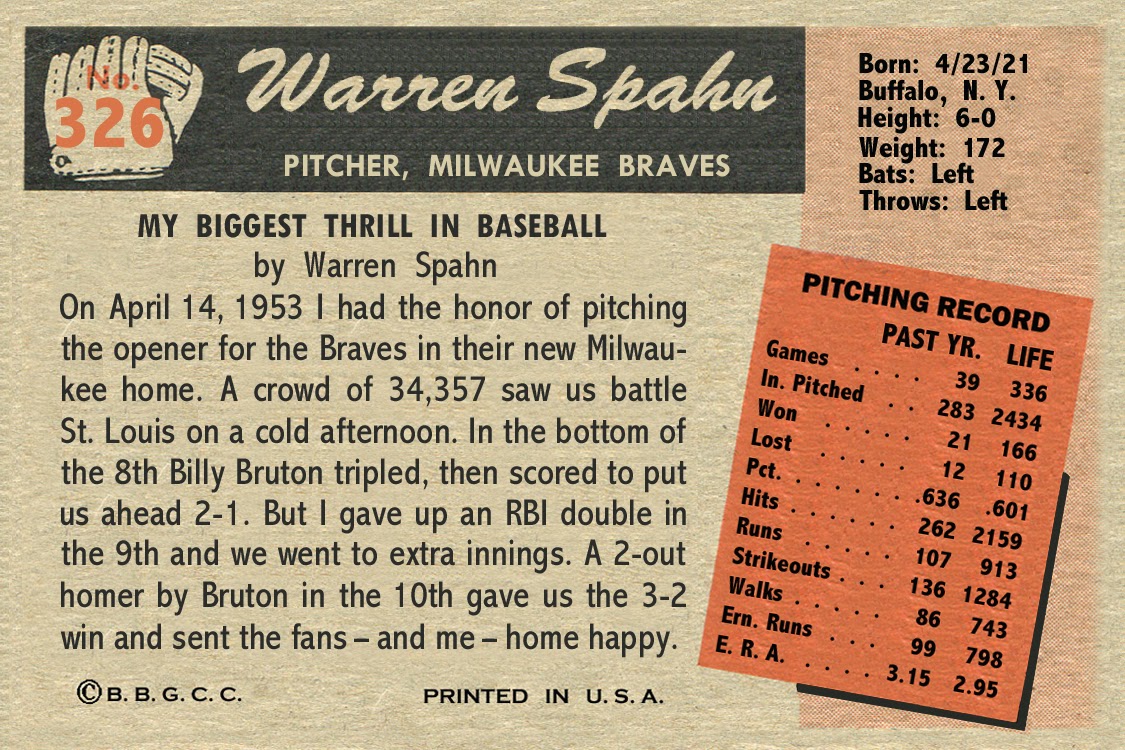
'54-'55 customs complete Spahn's Bowman run


It's fitting that Warren Spahn was included in so many baseball card sets during the "bubblegum wars" years of 1948-1955. He was one of the most dominant pitchers in the major league for nearly two decades and may have been the best left=handed pitcher of all time.

During the late 1940s and early 1950s, Spahnie was a true egalitarian when it came to bubblegum cards. He appeared in Bowman's initial baseball card set in 1948 and in the Leaf set of 1949. Spahn was in the Bowman issues of 1949-53, as well.

When Topps came along in 1951, Spahn was in the Brooklyn company's Red Backs set. He would then be found in every regular Topps set, and many of their auxiliary issues, every season through the end of his major league days in 1965.

The only gaps in this opus appear in Spahn's absence from the final Bowman baseball card issues of 1954 and 1955.

Spahn was one of my favorite Milwaukee Braves when I was a kid; we were both lefties. To this day, I'd still like to replace the 1953 Bowman card I had in my youth. I'd like to find a nice, bright VG card, perhaps with an autograph to match my Eddie Mathews '53B.

I'm surprised it has taken me so long to create some Warren Spahn custom cards. I've been squirreling away vintage pictures for many years.

Here's what I came up with in the format of 1954 and 1955 Bowman cards.

In the coming days I'll be working on at least two, and perhaps as many as four, more Spahn customs. I'll showcase them here when they're ready.


Thursday, February 26, 2015

Aaron's 2,000th-hit ball lost to history

At a ballgame in Philadelphia in 1964 one fan had a $10,000+ gift drop into his lap. Because the significance of the bequest went unrecognized, however, it has been lost to the hobby. 

No collector will ever be able to own the baseball that Hank Aaron hit for his 2,000th major league career hit on July 12, 1964.

It's likely that few of the 28,044 fans at the Sunday doubleheader at Connie Mack Stadium in Philadelphia knew that the ball was something special if they happened to snag it as a foul ball later in the game.

Fact is, there was no announcement made in the stadium about the milestone.

Aaron's 2000th hit came in the top of the 7th inning of the second game of the twin-bill, off Phillies reliever Jack Baldschun. It was a line-drive RBI single to left field, scoring Eddie Mathews to pull the Braves ahead 5-2 in the game they would win 6-2.

It was Aaron's second hit of the game, and he had gone 2-for-5 in the opener.

Apparently nobody in the announcer's booth was doing a countdown to 2,0000 or realized the significance of Aaron's hit.

Aaron himself didn't initially recognize his milestone. He said later that he didn't realize it until the next inning when he heard it on the radio in the clubhouse. By then, presumably, the 2,000-hit ball had been fouled into the stands and was in the hands of an unsuspecting fan.

A belated announcement of the accomplishment was made in the stadium the next day.

In today's baseball memorabilia market, you know Aaron's 2,000th-hit ball would have decent collector value, but just how much? In Nov., 2013, the ball Stan Musial hit in 1952 for his 2,000th hit sold in a heritage auction for $13,145. I'd guess Aaron's milestone ball would bring something in advance of that figure.

Topps recognized Aaron's 2,000th-hit in 2013 in a Baseball Flashback insert card in its Heritage issue, "Hank Hammers Hot No. 2000".


Tuesday, February 24, 2015

My 'oldest' All-American custom: 'Kangaroo Kicker' O'Dea


The original 1955 Topps All-American college football set contained a couple of stars from the 19th Century (Heffelfinger, Stagg), but until now I'd never found the inspiration to include a player of that vintage in my '55AA customs.

That changed when I discovered the tale of Pat O'Dea.

O'Dea was an Aussie who had played Australian rules football Down Under in 1893-95.

In 1896, when he was on his way to Oxford to study law, he stopped off in Madison, Wis., to visit his brother who was crew coach at the University of Wisconsin.

The story goes that O'Dea so impressed Badgers football coach Phil King with an impromptu kick that he was convinced to matriculate and played four seasons for the Badgers, who compiled a 35-5-1 record and two Big 10 conference championships 1896-99.

O'Dea may have been the greatest punter and field goal kicker of all time. He was so proficient that he was nicknamed the "Kangaroo Kicker" and was the toast of college football at the turn of the 20th Century, in the days before the forward pass was legitimized and at a time when a field goal tallied the same five points as a touchdown.

Some details of his reported on-field performance are subject to speculation, but there's no doubt he helped revolutionize football from a game of brute force to one emphasizing speed and athletic ability.

You can read a capsule career summary on the back of my card, and there are several biographies on the 'net available for the googling. Here's two of the best: http://www.theguardian.com/sport/blog/2014/mar/08/forgotten-story-patrick-odea
http://www.academia.edu/1931005/The_Legend_and_Mystery_of_Pat_O_Dea_the_Kangaroo_Kicker_

O'Dea went to California to practice law after World War I and "vanished" until 1934 when he was discovered living under another name, perhaps having become involved in an embezzlement.

He was elected to the College Football Hall of Fame in 1962 . . . and died the following day.

Fortunately for me, there exists a great studio portrait of O'Dea in a drop-kicking pose that gave me the essential element for my custom.

Now that I'm in the mood to add to my All-American custom "updates," I'll probably reel off another half-dozen or so in the next six-eight weeks . . . including a couple of more Wisconsin Badgers.


Sunday, February 22, 2015

Standard Catalog Update: Wilson's Meats, 1957 Borden's Dodgers

Response was good to my recent series of catalog updates of 1950s-1970s Baltimore Orioles issues.

I heard from a couple of other collectors who have additions to report to a couple of regional sets.

Since this blog is as good a place as any to make sure this type of information is preserved for hobby consumption, I'll try to help with that when I can.

Publishers of online or ink-on-paper baseball card references are welcome to pick up these periodic listings.


Wilson Meats issue dates extended

Until the report of a Wilson Meats premium picture of Frank Howard as a Senator was received from veteran vintage collector Larry Serota of Florida, it was assumed from the known checklist that these were strictly a 1961 issue.

The presence of Hondo in a Senators uniform has to be attributed to his time with Washington 1965-71.

Previously all known Wilson Meats premiums depicted players who were with the L.A. Dodgers or L.A. Angels in 1961.

This is the introduction I wrote for the Wilson Meats issue in the Standard Catalog of Baseball Cards some years ago:

It is likely these 5-1/2"x 8-1/2" photos were prepared for promotional appearances by players on behalf of the meat company. The player name and sometimes team name appears at the bottom of the photo and the sponsor's message appears at the bottom, "Courtesy of WILSON & CO., Inc., Fine Meat Products." Backs are blank. The pictures are often found with player autographs, another indicator of their use at personal appearances.

Prior to Larry's report of the Howard Senators picture, the checklist for the "1961" Wilson Meats promotional pictures was:
Ron Fairly, Dodgers
Gil Hodges, Dodgers
Frank Howard, Dodgers
Ted Kluszewski, Angels
Ron Perranoski, Dodgers
John Roseboro, Dodgers


Zim added to 1957 Brooklyn ticket promotion set

One of the more recent additions to the Standard Catalog was a listing for an issue of player pictures sponsored by Borden's dairy. 

Through the courtesy of New Hampshire collector Jack Webster, we now have an addition to what was previously a three-player checklist. The new addition is Don Zimmer.

The catalog intro for the set was:

In their final season in Brooklyn, the Dodgers partnered with Borden's to offer grandstand seat tickets to those redeeming five wrappers from various Elsie-branded dairy treats. The offer was promoted on the back of what appear to be contemporary team-issued picture pack photos. On the backs of the 5" x 7" black-and-white pictures is an illustrated advertisement providing details of the offer. This checklist is very likely incomplete.


The checklist at that time was:
Gino Cimoli
Sandy Koufax
Don Newcombe

I don't know how much time I'll have going forward to publish similar reports from readers, but I'll try to work them in when I can because it is important to preserve these reports for future collectors.

You can send reports to me at scbcguy@yahoo.com . 

Friday, February 20, 2015

Donny Anderson newest 1955 All-American custom


I'm surprised to find that it has been more than five months since I've presented an addition to my line-up of college football custom cards in the style of 1955 Topps All-American.

I've had a few ideas rattling around, but non-sports and baseball card projects have taken precedence. 

That changed the other day when I was reading 1964 issues of The Sporting News and found a feature about Texas Tech all-around star Donny Anderson.

Donny Anderson was Paul Hornung after Paul Hornung departed the Green Bay Packers. He was the fair-haired Golden Boy who could do it all on the field, even though he never approached Hornung's reputation off the field.

Donny had been all-state in football and basketball in Texas as well as a legitimate baseball prospect. He'd flunked out of Texas Tech his freshman year, but returned to the Red Raiders as a more mature, disciplined young man.

In the TSN article, his coach couldn't praise Anderson enough, extolling his proficiency as a blocking back, tailback, fullback, punter, pass receiver, kick returner and defensive back.

Anderson was a three-time All-Southwestern Conference halfback and was a consensus All-American in 1965. 

As a junior in 1964 he'd led the SWC in rushing yards and led the nation in total yards from scrimmage. In 1965 he led the conference in yards from scrimmage, pass receptions, and both receiving and rushing touchdowns.

Anderson was fourth in the 1965 Heisman Trophy voting, behind Mike Garrett, Howard Twilley and Illinois running back Jim Grabowski, with whom he'd pair in the Green Bay Packers backfield as the "Gold Dust Twins."

The Green Bay Packers picked Anderson in the first round of the 1965 NFL draft, #7 overall. Because of his academic redshirt season, he returned to Tech for the 1965 season. His bang-up season with the Red Raiders dramatically improved his bargaining position, as did the fact that it was rumored the Houston Oilers of the AFL were pursuing him.

When Anderson signed with Green Bay for 1966, his reported three-year $600,000 contract made him the highest-paid player in pro football history. He later quipped that was only fair because he was doing the work of five players.

With the Packers, Anderson rushed, caught passes, ran back punts and kickoffs, punted and even passed for a couple of touchdowns. 

In his role as Packers punter, Anderson had a lasting impact on that phase of the pro game. He pioneered in the concept of hang time as a way to shut down the punt return. Punting left-footed he put a high, hanging, backwards spiral on his kicks that confounded the receivers. In 1967 he averaged just 36.6 yards per punt, but only 13 of his 63 punts were returned for a total of just 22 yards, a 1.7 yards average. In his career he never gave up a punt-return touchdown. His success with this style of punting eventually forced the NFL to make rules changes to bring back the punt return as a scoring threat.

In Green Bay, halfback Anderson and fullback Grabowski were touted as the replacements for future Hall of Famers Paul Hornung and Jim Taylor, who were traded to the Saints after the 1966 season. 

Anderson was an integral part of the Packers' Super Bowl winning teams of 1966 and 1967. He is best remembered among Packer fans for his hit in Super Bowl I that knocked out Chiefs defensive back Fred Williamson.

Williamson was nicknamed "The Hammer" for his signature move of using karate-type blows to the helmet to disable opposing receivers. In the days leading up to the game he had been talking trash about how he was going to put Green Bay's receivers out of the game.

Ironically, it was Williamson who was carried off the field on a stretcher when he tried to bring down Anderson on a sweep and the running back's knee caught Williamson in the head. After the game, Packers end Max McGee commented that Anderson must have hit The Hammer with his wallet.

Anderson played for Green Bay from 1966-71. In Feb., 1972, he was traded to St. Louis for MacArthur Lane, playing with the Cardinals through 1974. He was traded to the Miami Dolphins prior to the 1975 season, but retired during training camp.

Now in retirement around Dallas, Anderson is a top-notch amateur golfer after spending a number of years on the PGA Celebrity Tour. 

I had considered also working up a 1966 or 1967 Philadelphia Gum-style of Anderson, who didn't make his football card debut until 1968 Topps. There is a surprising dearth, however, of color portrait type photos of Anderson as a young Packers star, suh as were most often used by Philly in those years.


Wednesday, February 18, 2015

At last . . . "Topps" cards for Tony Horton

Tony Horton was never really on my radar during his playing days in the 1960s. By the time he made the majors in 1964, my sports and card collecting interests had largely shifted to the American Football League.

Once I got involved professionally in the card hobby in 1980, I became aware of Horton's unusual card history. Though he played for seven seasons in the American League, Horton never appeared on a Topps card.

I recall Larry Fritsch was the person who brought this to my attention. We occasionally speculated on the lack of Horton Topps cards and whether the decision was made by the player or the bubblegum company.

We'll probably never know, because, as I recently learned, Horton steadfastly refuses to talk about his baseball life. 

An excellent biography of Horton, written by Mark Kanter and Mark Armour  can be found in the SABR Baseball Biography Project at http://sabr.org/bioproj/person/e1dbb148 . It was originally published in The 1967 Impossible Dream Red Sox: Pandemonium On The Field, edited by Bill Nowlin and Dan Desrochers, and published by Rounder Books in 2007.

Another perspective on Tony Horton, from Scott Raab, a contemporary Indians' fan is found in the 2010 book, Top of the Order: 25 Writers Pick Their Favorite Baseball Player of All Time. An excerpt can be found here: http://deadspin.com/5548412/taunting-tony-horton-the-day-after-he-slit-his-wrists-a-cleveland-fan-repents.

Horton's absence from Topps cards doesn't mean he left no baseball card legacy. After Marvin Miller revamped the Major League Baseball Players Association in 1968 with a new collective bargaining agreement and group licensing, Horton began appearing on various baseball card issues.

Among the cards on which he can be found are the 1969 Nabisco cereal box-back cards, 1969 MLB photostamps, 1969 MLBPA pins, 1969 Kahn's Wieners, 1969 Globe Imports (not licensed), 1969 Milton Bradley, 1971 Kellogg's 3D, 1971 Dell stamps and others. Horton was also included in a number of team-issue photopacks with the Red Sox and Indians.

Horton was also in at least one post-career card set, the 1978 TCMA "The Sixties" issue.

In recent years, a number of custom card makers have created various Topps-style Horton cards. Some of them use the same color photos as my newly created 1965, 1967 and 1970 style customs. That's to be expected since there are relatively few available color photos of Horton from his playing days. My customs differ from most in that I also create full backs for each card.

The photos I used on my Tony Horton custom cards are, surprisingly, all from the Topps' archives. Just because Horton wasn't appearing on their baseball cards didn't mean Topps wasn't taking his photo.

Regular reader of this blog know that for the past several months my card-making efforts have been concentrated on making "additions" to several of my favorite non-sports card sets of the 1950s and 1960s. 

I decided to switch gears back to baseball cards when a pair of Tony Horton/Red Sox photos appeared among the Topps Vault auctions on eBay. I'd already had in my files a 1969 Topps photo of Horton in an Indians uniform, courtesy of a hobby colleague.

There are just about enough other suitable Tony Horton photos to fill the gaps in the Topps line-up . . . 1966, 1968, 1969, 1971 . . . but I'll leave that to other custom card guys.


Saturday, February 14, 2015

Brooks Robby Queensgate mystery lid


For the past six days we have been presenting checklists, pictures, etc., of heretofore uncataloged or undercataloged Baltimore Orioles regional baseball cards of the 1950s-1970s.

The initial data was shared by Maine collector Alan Strout, who is veteran O's team-specialist.

Today we close this series with a mystery item from Strout's collection.

The pictured item is a plastic lid. It measures 8" in diameter and 1/8" thick. The name "QUEENSGATE" appears at the top. The player name appears below the posterized picture. At right, the item has been authentically autographed.

"I don't know anything about it," Strout said, "but I believe it's probably late 1960s or early 1970s. I thought it was really neat."

Readers who have any information about this plastic lid are encouraged to contact either Strout or me. My email is, in coded form, scbcguy(at sign)yahoo(dot)com . 

Based on some time poking around the internet, I'm going to hazard a guess as to this item's origin.

I'm guessing this item is more recent than Alan's estimate. I'd say 1980s or 1990s. While there are enterprises named Queensgate all over the country, I think this has its origins in York, Pa., where there is a Queensgate shopping mall and where in the 1990s there was a Queensgate Cinemas theater complex.

York is less than an hour north of Baltimore. Robinson has significant baseball ties to York. He began his pro ball career in York in 1955, hitting .331 for the York White Roses, a Class B (Piedmont League) farm club of the Orioles.

Since 2006, Robinson has been part of the ownership of the York Revolution, of the independent Atlantic League.

I speculate that the plastic lid originated from the Queensgate theater in York. It may well have been the top of a really large soft drink or slushy drink, or a small bucket of popcorn sold at the concession stand. 

Again, this is just my wild-ass guess. If you have more definitive information, or even your own speculation, please share.

If you wish to contact Strout about the Orioles regionals you'll see in this series or exchange information about other O's issues, you can email him. I'm going to give his email address here in "coded" form so the robo-scanners don't add it to their spam lists. You can reach Alan Strout of Maine at (his first name)_(his last name)(at symbol)umit.(his state).edu Strout can also be reached by mail at P.O. Box 84, Kenduskeag, ME 04450. 

Friday, February 13, 2015

1964 Orioles Family Night set now "cataloged"


I haven't been officially associated with the Standard Catalog of Vintage Baseball Cards for a number of years but the zeal to expand the hobby's knowledge base hasn't yet ebbed.

That's why I've been working with veteran Baltimore Orioles specialist collector Alan Strout to place in the public record some great new information about various 1950s-1970s O's regional baseball card issues that have been heretofore uncataloged or under-cataloged.

Given the permanence of data on the internet, Strout's generous contributions to the hobby are now officially on record. Perhaps the publishers of the ink-on-paper hobby references will see fit to add these listings to their books.

Presented here is a set of rare Orioles regionals that I never encountered in my 20+ years of working on the "big book." It is a 14-card set issued as a stadium giveaway in conjunction with Martin Family Night at Memorial Park on July 17, 1964.

According to Strout, during the middle to late 1960s, the Orioles used to have family nights at the ballpark sponsored by local companies. 

Strout says that special game-day programs were printed and that on some of these occasions, the team produced photo booklets of between 8-13 current players. The booklets featured 5" x 7" perforated player portraits, similar in format to contemporary Jay or team-issued picture pack photos. 

In 1964, on Martin Family Night, the team issued a set of 3" x 4" blue duotone baseball cards. Shown here are the front of Jerry Adair's card and back of Luis Aparicio.

The Glenn L. Martin Co. was founded in Baltimore before World War II, producing aircraft. In 1961 it merged with American-Marietta Corp and quickly rose to prominence in the aerospace industry as a leader in missile technology; they were the developer of the Titan missile program. In turn, the company merged with Lockheed in 1995 to create the Lockheed-Martin aerospace firm.

Martin Family Night in 1964 saw the Orioles host the Detroit Tigers. The crowd of 22,629 saw their league-leading O's win 0-5. Robin Roberts pitched the shutout though he gave up 11 hits and walked two. 

Presumably the Martin Family Night cards were given out as complete sets, though I don't have information on how many were distributed. Strout said that he owns a set and knows of one other, "but that certainly doesn't mean that there aren't more."

The fact that I have never previously encountered these cards leaves me wondering where the rest of the survivors are.

The checklist for the set comprises . . . 
(1) Jerry Adair
(2) Luis Aparicio
(3) Steve Barber
(4) Jackie Brandt
(5) Wally Bunker
(6) Dick Hall
(7) Bob Johnson
(8) Willie Kirkland
(9) John Orsino
(10) Milt Pappas
(11) Boog Powell
(12) Robin Roberts
(13) Brooks Robinson
(14) Norm Siebern

One lucky fan got his Martin Family Night
program autographed by Brooks Robinson, Hank
Bauer, Gene Woodling, Luis Aparicio, Norm
Siebern and Boog Powell.

If you wish to contact Strout about the Orioles regionals you'll see in this series or exchange information about other O's issues, you can email him. I'm going to give his email address here in "coded" form so the robo-scanners don't add it to their spam lists. You can reach Alan Strout of Maine at (his first name)_(his last name)(at symbol)umit.(his state).edu Strout can also be reached by mail at P.O. Box 84, Kenduskeag, ME 04450. 

Tomorrow we'll conclude these presentations with an uncataloged Brooks Robinson item that has perplexed O's specialist Alan Strout. 

Thursday, February 12, 2015

1962-63 Baltimore News-Post scrapbook cards


1962 Baltimore News-Post Scrapbook cards

Quite similar in format to the previous year's Orioles scrapbook cards, the 1962 newspaper cards were also not numbered when they were published during spring training; numbers have been assigned here alphabetically. It is not out of the realm of possibility that because the scrapbook cards were not numbered an heretofore unreported straggler may show up some day,

The format for the 1962 pictures remained a nominal 5" x 8". Besides the picture and facsimile autograph, the card had personal data including name, position, birth date and place, place of residence, batting and throwing preference, information on family members and a space for an autograph.

The paragraphs of career data and season prospects were replaced by compete major and minor league stats.

The set included not only veteran players, but top minor league prospects, coaches and the manager. A number of players found in this set do not appear on any other baseball cards.

(1) Jerry Adair
(2) Steve Barber
(3) Jackie Brandt
(4) Harry Brecheen
(5) Marv Breeding
(6) Hal Brown
(7) Steve Cosgrove
(8) Cal Ermer
(9) Chuck Estrada
(10) Andy Etchebarren
(11) Jack Fisher
(12) Hank Foiles
(13) Jim Gentile
(14) Dick Hall
(15) Larry Haney
(16) Ron Hansen
(17) Whitey Herzog
(18) Billy Hitchcock
(19) Billy Hoeft
(20) Ron Kabbes
(21) Darold Knowles
(22) Charley Lau
(23) Jim Lehew
(24) Dave Massarelli
(25) Dave McNally
(26) John Miller
(27) Dave Nicholson
(28) Joe Nuxhall
(29) Bill Oplinger, Jr.
(30) Milt Pappas
(31) Boog Powell
(32) Art Quick 
(33) Brooks Robinson
(34) Earl Robinson
(35) Bob Saverine
(36) Billy Short
(37) Russ Snyder
(38) George Staller
(39) Howie Stethers
(40) Wes Stock
(41) Johnny Temple
(42) Marv Throneberry
(43) Gus Triandos
(44) Ozzie Virgil
(45) Pete Ward
(46) Hoyt Wilhelm
(47) Dick Williams

Check back tomorrow for information and checklist of the 1963 Baltimore News-Post scrapbook cards.


1963 Baltimore News-Post Scrapbook cards

Almost identical in format to the previous year's Orioles scrapbook cards, the 1963 newspaper cards were also not numbered when they were published during spring training; numbers have been assigned here alphabetically. It is not out of the realm of possibility that because the scrapbook cards were not numbered an heretofore unreported straggler may show up some day,

The format for the 1963 pictures remained a nominal 5" x 8". Besides the picture and facsimile autograph, the card had personal data including name, nickname, position, birth date and place, place of residence, batting and throwing preference, information on family members, space for an autograph and compete major and minor league stats.

The set included not only veteran players, but top minor league prospects, coaches and the manager. A number of players found in this set do not appear on any other baseball cards.

(1) Jerry Adair
(2) Luis Aparicio
(3) Luke Appling
(4) Steve Barber
(5) Hank Bauer
(6) Mark Belanger
(7) Frank Bertainia
(8) Paul Blair
(9) Jackie Brandt
(10) Harry Breechen
(11) Dick Brown
(12) Pete Burnside
(13) Steve Dalkowski
(14) Chuck Estrada
(15) Andy Etchebarren
(16) Joe Gaines
(17) Jim Gentile
(18) Dick Hall
(19) Larry Haney
(20) Billy Hitchcock
(21) Bob Johnson
(22) Davey Johnson
(23) Darold Knowles
(24) Hobie Landrith
(25) Charley Lau
(26) Dave May
(27) Mike McCormick
(28) Dave McNally
(29) John Miller
(30) Stu Miller
(31) Les Narum
(32) John Orsino
(33) Milt Pappas
(34) Boog Powell
(35) Robin Roberts 
(36) Brooks Robinson
(37) Bob Saverine
(38) Al Smith
(39) Russ Snyder
(40) Roger Sorenson
(41) Herm Starrette
(42) Wes Stock
(43) Eddie Watt

Tomorrow we'll present one of the rarest Baltimore Orioles regional baseball card sets.