Showing posts with label Warren Spahn. Show all posts

Friday, January 8, 2016

Dodgers' home field was anathema to Spahn


Regular readers of my blog have probably figured out that I am a big fan of Warren Spahn.

He was the ace of the Milwaukee Braves staff during my childhood and probably the second-greatest left-handed pitcher of all time.

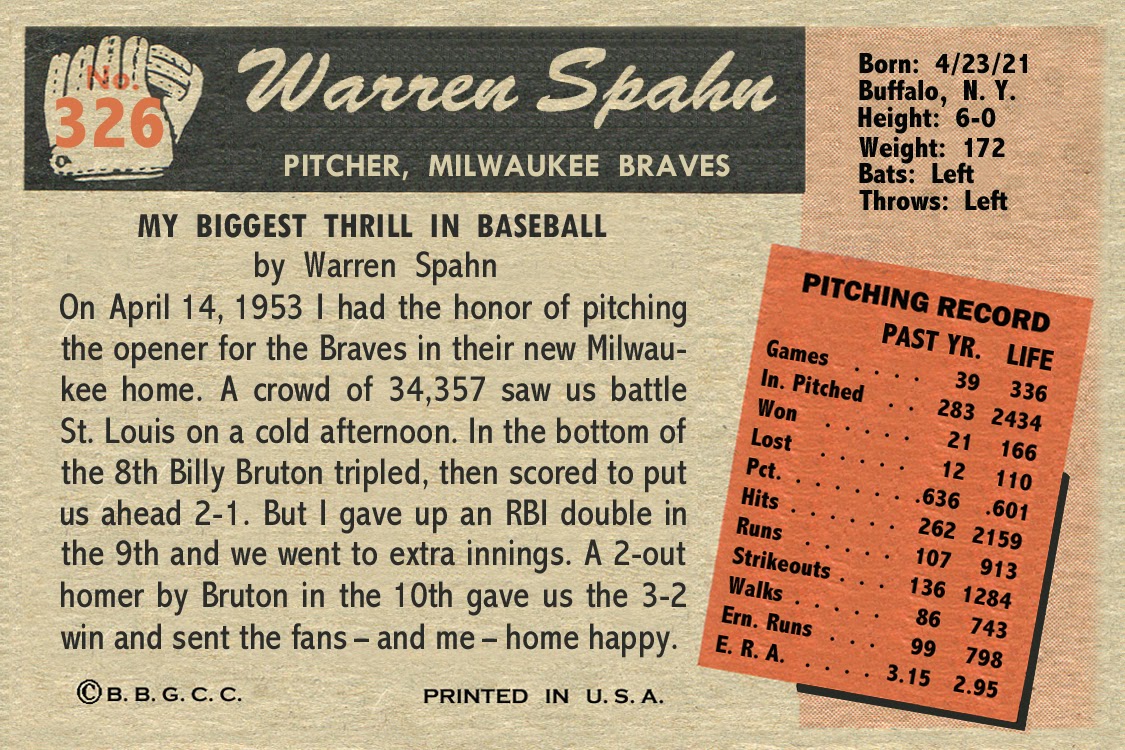
Among my custom card creations are two that picture Spahnie as a Braves pitcher, in the format of 1954 and 1955 Bowman. I've also done an alternative version of Spahn's 1965 Topps card as a Mets pitcher. There are two cards, 1969 and 1971 Topps-style, marking his time as manager of the Tulsa Oilers. I've also done a 1972-style card of Spahn as a Cleveland Indians pitching coach. There may even be a few more Spahn customs down the road.

As I read microfilm of back issues of The Sporting News, I'm always drawn to articles and feature about Spahn. One such in a mid-1963 issue caught my attention because it hit on another area of personal interest: streaks.

According to that article, between the second game of the Aug. 21, 1948 double header and June 28, 1963, Spahn never won an away game against the Brooklyn/L.A. Dodgers; not in Ebbets Field, not in the L.A. Memorial Coliseum and not in the Dodgers' new stadium in Chavez ravine.

Prior to the beginning of the 9/48 to 6/23 losing streak, Spahn had faced the Dodgers in Brooklyn nine times. In his rookie season of 1942 he had no decision in his first-ever appearance there on April 20. After serving three years in the army during World War !!, Spahn was 1-1 with a no-decision in 1947. He was 2-1 with a save at Ebbets in 1948 prior to the start of his bad-luck skein.

During that drought, Spahn lost once more at Ebbets in 1948, twice in 1949 (though he did earn a save in relief on Aug. 22), five times in 1950, twice in 1951 and once in 1952.

Spahn got a no-decision in his only game at Ebbets in 1953, being knocked out of the box early with Milwaukee behind 4-2. They rallied for a 9-8 victory.

By the mid-1950s, Braves manager Charlie Grimm took the jinx seriously and Spahn did not pitch at Ebbets Field (or Roosevelt Stadium, for that matter) at all in 1954-1957.

The Dodgers' move to Los Angeles in 1958 did not change Spahn's luck against the team on their home field. He lost once and had a no-decision that season at the Coliseum.

In 1959, Spahn lost once in L.A., had a no-decision and a blown save. In 1960 he only pitched there once, with no decision. In 1961, Spahn lost twice at the Coliseum.

His luck was no better at the new Dodger Stadium; he lost his only game there in 1962.

Spahn had accumulated 16 losses, three no-decisions and a blown save against the Dodgers on their home field between Aug. 21, 1948 and June 28, 1963.

When he finally broke the streak, he did so with one of the finest performances of his career.
On June 28, the 42-year-old lefty had a perfect game going into the seventh inning before giving up a single to Jim Gilliam. Later in the game Frank Howard and Maury Wills also singled. While Spahn was completing his shutout, Don Drysdale, on the mound for the Dodgers, also had a good game going. He scattered seven hits and allowed just one run before taking the 1-0 loss. The win was the 338th for Spahn, and his 58th shutout.

With the ice broken, Spahn won again the next time he appeared in Los Angeles, beating the Dodgers 6-1 in a complete-game effort Aug. 23.

In 1964, his final year with the Braves, he had an eight-inning no-decision on April 19 and took a loss there on June 16.

The first time Spahn pitched in Los Angeles after being sold to the Mets for the 1965 season, he notched a win, going to 1-1 with a loss there on June 20. After being released by the Mets and signing as a free agent with the Giants, he pitched just once more in Dodger Stadium. He started the Sept. 6 game but was lifted in the second inning, not figuring in the decision.

Whether home or away, Spahn fared worse against the Brooklyn/L.A. Dodgers than any other team during his entire career, 1942-1965. He appeared against them 77 times, with a 24-37 (.393) record. (Actually, Spahn's record against the Milwaukee Braves in 1965 was 0-2, but that's not statistically important.)

Besides the regular season, Spahn pitched in the Dodgers' home park once in the All-Star game on the Dodgers' home field. In 1949 he started for the National League at Ebbets Field. He gave up four hits and four runs in 1.1 innings. He did not have a decision in the 11-7 loss to the AL. In the second All-Star game of 1959, he was named to the NL team (as he was 17 times in his career), but did not appear. The game was played Aug. 3 at the Coliseum, and Spahn was scheduled to start the next day in San Francisco.


*  *  *

Another Spahn item found in TSN in mid-summer 1963 concerned picture-taking at the All-Star game.

A photographer was posing Spahn and Koufax and asked if the two lefties could stand closer together. "We can't get these noses any closer," Koufax said, grabbing Spahn's honker.

In a similar vein, at some occasion or other comedian Bob Hope asked Spahn to autograph a photo. Spahn was reported as personalizing the portrait, "To Old Ski Nose from Old Hook Nose."


Monday, June 8, 2015

'63 Spahnie buttons funded scholarships


One of the greatest bargains among original Milwaukee Braves souvenirs of 1963 is the "Spahnie" pinback button issued in conjunction with Warren Spahn Night at County Stadium on Sept. 17.

Even today, an example of the 2" diameter red, white and blue button in like-new condition can be had for less than $10.

The low price for a 50+-year-old bit of Braves Hall of Famer memorabilia can be largely attributed to the fact that, extrapolating from news accounts, there may have been as many as 200,000 of the buttons issued. A contemporary newspaper account indicated that as much as $50,000 was projected to be raised by sales of the 25-cent buttons.

The button sales were designed to create, along with private gifts, initial funding for the Warren Spahn Scholarship Foundation. The foundation was created to annually provide two sophomores at Wisconsin colleges or universities $1,000 scholarships for their junior and senior years.

A cursory google-search failed to provide any indication that the foundation is still in existence today.

A good luck at the festivities that comprised Warren Spahn Night has been written by Milwaukee Braves fan extraordinaire Dave Klug. With his permission I'm excerpting here . . .

(On) September 17th, 1963, the Braves and the good folk of Milwaukee and fans far and wide held a gala Spahnie Night Celebration.

Fans were encouraged to buy and wear their Spahnie buttons ... all monies realized from button sales (went to) a Spahn Scholarship Fund. During the planning stages, Spahn insisted that there be a minimal amount of gifts to him or his family and that all monetary gifts go to the Scholarship Fund.

The festivities actually got underway at a 12:30 P.M. kick-off luncheon at the Wisconsin Club on Wednesday the 16th.

Among the notables at the luncheon were Fred Haney, Bob Feller and Lefty Grove . . . and Spahn's catcher from his army days, Roy Reimann. Spahn admitted to being "a little choked up" and gave credit to his teammates as "the real guys who are responsible for me being up here".

The largest crowd of this year -- 33,676 -- turned out to pay tribute to one of their long-time heroes. Most of them remembered to wear their Spahnie buttons. The program started late due to multiple traffic jams on the Freeway.

Every one who was there -- from Lefty Grove, Johnny Sain, Carl Hubbell and Gabby Hartnett to the ardent fan in the stands to the media people to the fans who couldn't attend -- had their own special memories of Warren Spahn. Some got to voice them, some just had them in their hearts. A well-known baseball fan, President John F. Kennedy sent a letter that said in part: "Dear Warren . . . You are one the few men in the history of baseball who has the distinction of establishing new records of achievement and new historic landmarks in each game in which you play. Your . . . years of success . . . have been a testimony to your strength and character, competitive zeal and physical stamina. Few athletes in our time have won the universal admiration which you have in your many years as a player". The crowd was in whole-hearted agreement. There was a sign in the stands that read "Wisconsin nominates Warren Spahn for President".

Each National League Club sent a player -- in uniform -- to make that team's presentation. Frank Bolling was selected as the Braves team representative at the celebration. The team gave Spahn wood-working machinery for his wood-shop at home in Hartshorne, OK. Lorene Spahn and son, Greg also received gifts.
(Mrs. Spahn received a jewelry box and Greg, then age 14, got a Western saddle). 

When the already-legendary left-hander finally came up to speak, the crowd gave him a two-minute standing ovation. When things quieted down a bit, he said, "I'm sure there have been more fortunate people but, I'm the luckiest guy in baseball. I'm sure these guys would agree (pointing to the Giants team -- that night's opponent -- everyone laughed). My sincere thanks from the bottom of my heart for making this occasion and this Scholarship Foundation possible. God bless you."

The whole atmosphere of the evening was celebratory with the Stadium decorated in bunting plus a fireworks display. Organizers announced that they had already received $30,000 toward the scholarship fund and estimated they'd probably be getting another $40-$45,000. 


While the Spahn Night celebration was universally acclaimed a success, the ensuing game was not.

Seeking his 21st win of the season and 348th of his career, Spahn took the mound against Bobby Bolin of the Giants. He was shelled for five hits and four runs before being taken out after three innings. The Braves lost 11-3. It was their eighth loss in a row and dropped them from fourth to sixth place in the NL.

Spahn closed out his season with three straight wins, bringing his total to 23 and matching his career best.


While the Spahnie buttons are ubiquitous, a related piece of memorabilia is much scarcer today. A large, heavy cardboard sign, measuring 14" x 22" and advertising the sale of the buttons, is worth $600-750.

Monday, June 1, 2015

1962 Post customs complete the trilogy -- for now

The completion of a six-card sheet of 1962 Post cereal custom baseball cards, in the form of a recreation of a cereal box-back, ends phase one of a project I began a couple of months ago.

I introduced the project on this blog on April 24, showing off my 1961 Post customs. On May 14 I presented by seven-card panel of 1963 cards.

Now I give you my 1962-style creations. I saved the '62s for last because they were my favorite among the three years of Post 200-card sets.

To get a feel for the whys and wherefores of my Post customs, it might be a good idea to go back and look at the April 24 and May 14 blog entries so I don't have to repeat it here.

As in past presentations, I'll have just a few words about my player selections.

Gene Conley. Any Milwaukee Brave, or even a former or future Brave, is liable to find his way onto one of my custom cards. That was the case with Conley. Big Gene was originally included by Post only in its 1961 set, with the Phillies. By that time, however, he'd been traded to the Red Sox. My card recognizes Conley's move to the AL.

Gil Hodges. Hodges had a "real" card in the 1962 Post set, but was pictured as an L.A. Dodger. Post wasn't able to reflect the expansion Mets and Colt .45s of the NL on its 1962 cards, beyond some "drafted by . . . " lines on some of the cards. My card shows what such cards might have looked like if Post had done some additional cards later in the year.

Stan Musial. Though he was near the end of his playing days, and his productive years were behind him, in 1962 Musial was still one of the most popular players in the game. He didn't appear in any of the original Post cereal sets; this is what a 1962 card would have looked like.


Warren Spahn. The game's greatest left-hander appeared on Post cereal boxes only in 1961. Perhaps the company expected him to retire each year thereafter, but he hung on through the 1965 season, adding to his career totals. 


Billy Williams. Williams appeared in the 1963 Post set, where he is a high-priced short-print. It's not too much of a stretch to think Post could have included him in 1962; so I did.


Robin Roberts. Roberts is another player who did have a card in Post's original 1962 set. It pictured him as a Phillie and mentioned his trade to the Yankees. My "update" pictures him with New York and recognizes his move to the Orioles. Roberts was on the Yankees' roster from Oct. 16, 1961 through May 21, 1962, but never pitched in an official game for them.

As I said, these 1962 customs represent the end of the first part of what looks to become an on-going project.

I'm going to be doing something in the style of Post's 1962 football cards in a couple of months. I've also got a special 1962 Post Tens tray-bottom in mind and will likely tackle at least one more box-back of 1963 cards.


Saturday, March 14, 2015

Final Spahn custom is '65 make-over


I've spent a lot of time this past month working on six custom cards of one of all-time favorite Milwaukee Braves, Warren Spahn. You can find information on my 1954 and 1955 Bowman-style Spahn cards in my blog entry of Feb. 28. My 1969 and 1971 Topps-style Tulsa Oilers manager's cards were detailed here on March 4, and my 1972 Indians coach card was shown on March 11.

This reworking of a 1965 Topps-style card of Spahnie as pitcher-coach of the N.Y. Mets is likely to be my final Spahn custom.
The "real" 1965 Topps
Warren Spahn card.

You can't fault Topps for its 1965 Warren Spahn card. He was sold from the Braves to the Mets in November, 1964, and the gum company wouldn't have had the opportunity to get a photo of Spahn on Mets uniform in time for its Third Series. Thus he's pictured capless in a Braves jersey on card #205.

I, on the other hand, could take advantage of numerous quality color images of Spahn in an actual Mets uniform to come up with my remake.

In doing my research on Spahn's post-Milwaukee days, I learned a lot I didn't know, principally from reading back-issue microfilm of The Sporting News. In 1965 I had put my card collecting on hiatus and, for the most part, abandoned my interest in baseball in favor of following the American Football League.

What I found most interesting in my review of 50-year-old baseball "news" was the feud that had developed between Spahn and Braves manager Bobby Bragan in 1964, and led to the player and team parting ways.

In the Dec. 19, 1964 Sporting News, the paper's Milwaukee correspondent aired the dispute in this article.

Scathing Words Fuel Hot Feud
As Bragan, Spahn Swap Insults

By BOB WOLF
MILWAUKEE, Wis.

Manager Bobby Bragan of the Braves pulled no punches in a verbal blast at Warren Spahn, the future Hall of Fame candidate who was sold to the Mets recently.
Bragan said that the 43-year-old veteran, winningest lefthanded pitcher of all time, had been so ineffective last season that only his “name” had kept him in the major leagues. He also charged that Spahn had worried only about himself and his $80,000 salary.
Spahn returned the fire, saying, “Bragan does things like that.” He added that the outspoken manager had also said uncomplimentary things about other players after they had left the Braves.
The duel of words actually started the day Spahn was sold to the Mets, November 23. Spahn hinted then that every move made by Bragan and Braves’ President John McHale last season seemed to be predicated on the rumored switch to Atlanta. He said, among other things, “Just when a player would get hot, Bragan would take him out of the lineup.”
Salary-Minded, Bragan Says
            Bragan’s barrage went like this: “Spahn could have helped us a reliever late in the season if he hadn’t been thinking about that $80,000 salary of his. He knows he can’t be cut more than 25 per cent under baseball law, so he can bluff his way through next season and still not take a very big salary cut. He’s not thinking of the team. He’s thinking about Warren Spahn—the great Spahnie.
            “He’s a future Hall of Famer and an immortal and all that stuff. But let me tell you that if any other pitcher had been shelled the way he was last season, he would have been shipped to Denver. But this was Warren Spahn and he had to be handled with great care, even if he couldn’t get anybody out.
            “He got old all of a sudden. After all; he was 43 and how long did he expect to go on? Other great players have faced up to it and quit—Stan Musial, Joe DiMaggio. But not Warren Spahn.
            “He stopped smoking and that’s dangerous because a guy has a tendency to eat when he’s used to reaching for a cigarette. He was ten to 15 pounds overweight all season. He was dead on his feet. His legs were gone. He couldn’t get off the mound and they were bunting him silly.  On top of that, his control was terrible.
            “I see now that he’s shooting off his mouth about how I didn’t start him enough and that he can win those 44 games he needs to hit 400. Truthfully, I started him too often.”
            Bragan said that Spahn had been offered a radio job with the Braves for $50,000, and said, “You think he’d take that? You think he’d come down to $50,000 a year? Not good old Spahnie.”
            And here is Spahn’s retort: “Bragan does things like that. He hasn’t said anything about me that he hasn’t said about other players who left the club. Lou Burdette, Del Crandall, you name them.
            “But I prefer not to get into a running argument with him. All I’m interested in is having a good year with the Mets and proving that Bragan is wrong.
Blames Inactivity for Wildness
            “I don’t deny that my control was off, but I’ve always contended that a pitcher has to work regularly and I wasn’t doing that the last half of the season.
            “I thought we had the best club in the league, but when he did things like starting a couple of rookies (Dan Schneider and Clay Carroll) in a double-header at Chicago, it made you wonder whether he wanted to win.
            “Talk to the other players about Bragan. You’ll find out how much he was disliked.
            “As for the radio job he was talking about, I never received anything like a concrete offer with definite terms. They got rid of me because of the money—my salary.”
            Asked whether he would have retired rather than play for Bragan again, Spahn said, “I wouldn’t have let him run me out of baseball.”

            Despite the Spahn-Bragan war of words, the Braves’ stockholders voted unanimously at their Dec. 11 meeting to retire Spahn’s uniform number 21, worn during his 20 seasons with Boston and Milwaukee.
           
            (At that same stockholders meeting, all of the Wisconsin members of the Braves’ board of directors were ousted, including Vince Lombardi. Nominated for a seat on the board, but roundly defeated, was “Allan (Bud) Selig, Milwaukee automobile dealer.”)

            Spahn was able to get uniform number 21 from the Mets when first baseman Ed Kranepool, who had worn the number since the team was formed, gave it to the veteran. Kranepool took #7. Later in the year, when Spahn went to the Giants, he was given #21 by Len Gabrielson, who also took #7.

            As the new year rolled around, Spahn tried to quell the war of words with Bragan, telling the Milwaukee writers, “I would like to prove Bragan wrong by my deeds rather than by any comments. I want to do well in 1965 to make him eat his words.”

            Bragan, however continued to publicly needle Spahn.

            At the Milwaukee Baseball Writers’ annual Diamond Dinner on Jan. 24, the Braves’ manager, in his dinner speech, said, “I’d like to say that one of the basic reasons we thought it best for Spahnie to go to the Mets was that he and Casey Stengel had more in common. Not age—wealth. As far as I’m concerned, Spahnie, there’s no feud and I hope you win 400 games.”

            Bragan then recited a little verse, “Whatever I said in anger and whatever I shouted in spite, I’m sorry that I said those words, ‘cause I thought of some worse ones last night.”

            Spahn sat expressionless during Bragan’s remarks and did not answer them when he spoke later in the program. He poked a little fun at himself when he said, “It is wonderful to be here. Not many six-game winners are honored like this.”

            After a brief contract dispute, Spahn took up his duties with the Mets at spring training. It was reported that he would be paid $65,000 as a player-coach, about 20% less than his last Braves salary. Baseball rules at the time would have allowed New York to cut his salary by a maximum of 25%.

            Spahn made his Mets mound debut starting the second game of Grapefruit League spring training against the World’s Champion St. Louis Cardinals. He pitched three innings, giving up four hits and three runs, walking three and striking out one in taking the 3-4 loss to Bob Gibson. Fellow player-coach Yogi Berra was behind the plate during Spahn’s outing.

            He took the mound again on March 20, pitching four innings of scoreless relief in a 2-3 loss to the White Sox.

            In his last two spring training games, Spahn started and got the wins. On March 25 he defeated the Yankees 3-2; on April 4 he beat the Tigers 3-4.

            Spahn’s win over the Yankees came largely as a result of his hitting. He was 2-for-2 with a sac fly at the plate, including a home run and two RBIs. Against the Tigers he continued his hot hitting with a 2-for-3 day and another pair of RBIs.

            While Spahn was 2-2 in his spring training exhibitions, the Mets didn’t fare as well. They had a spring record of 11-15-1, worst among NL teams.

            Spahn made his first appearance back in Milwaukee for special pre-game ceremonies at the Braves’ final opening day in Milwaukee on April 15. He had started and gone eight innings in a no-decision against the Astros in New York the previous day. He and other members of the 1953 Braves team were introduced and trotted out to the positions they had played when the team debuted in Milwaukee in 1953. He was attired in his Mets uniform and received a standing ovation.

            Returning to his new team, Spahn won his next two starts, both complete games, at Los Angeles and San Francisco.

            Spahn got another win on May 3, but it doesn't appear in the official record. He was credited with the Mets' victory over the N.Y. Yankees in the annual Mayor's Trophy Game, which benefited New York sandlot baseball projects. Spahn pitched one inning in relief in the 2-1 10-inning victory. Fellow Mets player-coach Yogi Berra did not appear in Yankee Stadium in the game against the team that had fired him after losing the '64 World Series.

            When he made his first appearance on the mound back in Milwaukee on May 20, his record was 3-3. The turnout was the largest since opening day and they were there to cheer on their old hero. Spahn cruised through the first four innings, shutting out the Braves on just two singles, walking nobody and striking out a pair. The wheels came off in the fifth. He gave up seven earned runs, including a grand slam to Eddie Mathews. Spahn took the loss 1-7. 

          Spahn rebounded on May 24th with a 6-2 victory at Philadelphia. The win was career number 360 and it raised him to sixth place on the all-time major league wins list. Later in the season, on Sept. 27 while pitching for the Giants, Spahn got St. Louis Cardinals catcher Bob Uecker looking at a called third strike. It was strikeout number 2,528, breaking a tie with Bob Feller and moving Spahnie up to third place on the all-time career strikeouts list. At that time he was behind only Tim Keefe and Cy Young on the list.

         On June 29, Spahn again took the mound against the Braves when Milwaukee visited Shea Stadium. He lost again, 8-6. It was his seventh straight losing decision, bringing his season record to 4-11. In six innings thrown, he gave up eight hits, including home runs to Frank Boling, Gene Oliver and Eddie Mathews.

         Spahn had been unable to make Bragan “eat his words.”

         With the Mets mired in last place, 27-1/2 games off the pace, Spahn was given his release on July 17. Two days later, the S.F. Giants, picked him up to bolster their staff in the midst of a pennant race. 

          At the time, San Francisco had only two left-handers on its pitching staff, both relievers, Bill Henry and Masanori Murakami.

         Giants manager Herman Franks was not exactly effusive over his new staff addition. "What can we lose?", he asked rhetorically. Maybe he's through, maybe he isn't. So let's take a look. We'll use him as a spot starter and middle-inning relief man. He can win a couple of games for us. And in a pennant race such as we have going, a couple of wins could be the difference."

         Spahn made his Giants debut in San Francisco on July 22 against the Reds. The press reported he got a standing ovation as he took the mound to start the game and another when he was lifted in the top of the third with the Reds ahead 3-1. 

          Though he didn't factor in the decision, Spahn had immediately paid dividends for the Giants. Paid attendance was nearly 18,000, with nearly 12,000 more ladies' day and kids' tickets swelling the crowd. A Giants official credited the crowd to Spahn, saying they would normally expected fewer than 10,000 at a Thursday afternoon game.

          The second batter Spahn faced in his Giants bow was Pete Rose, who homered. The blow brought Rose's 1965 average against Spahn to .692 (9-for-13). Overall, in the years Spahn faced Rose (1963-65), the Reds' infielder compiled a .531 average (17-for-32) against him.

          The Giants climbed from fourth place to first between the time Spahn joined the team and Sept. 7. They held onto the pennant lead until Sept. 28, finishing the season in second place.

            Spahn took his regular turn as a starter, with occasional relief appearances, for San Francisco through the end of the season, winning three more and losing three more to end his season with a 7-16 record and an ERA of 4.01.

            His last outing against the Braves had come in Milwaukee on Aug. 1. He pitched two innings in relief to close the game with a 2-4 loss, though he didn’t figure in the decision.

            When Spahn had joined the Mets as pitching coach, he found a staff that over the season averaged just 25 years of age. Of the 20 pitchers who took the mound for the Mets in 1965, only three achieved winning records and the team ended the year last in the National League in losses, saves, ERA and strikeouts.

            By insisting on being carried as a player-coach, Spahn had deprived the Mets of one roster spot, though it’s unlikely that had any effect on the team’s 50-112 record.

            As I mentioned, this will likely be my last Spahn custom. In the absence of any suitable color photo of Spahn with San Francisco, it would be easy enough to colorize an extant black-and-white portrait photo of Spahn in a Giants cap for a 1966-style card. I have yet to see any photo of him when he was with the Mexico City Tigers in 1966. While there are several nice photos of Spahn with the Angels as a coach in the 1970s, I haven't found any photos of his days with the Hiroshima Toiyo Carp in Japan in the 1970s.

Thus, tis seems to conclude my custom card homage to Warren Spahn.


Wednesday, March 11, 2015

1972 Topps-style Spahn custom


I really don't have any backstory for my latest, and likely penultimate, Warren Spahn custom card. There was a great photo available and it worked out well in the 1972 Topps style.

Spahn's years (1972-73) as pitching coach for the Cleveland Indians were called "unhappy" by his biographer Jim Kaplan in the SABR Baseball Biography Project  http://sabr.org/bioproj/person/16b7b87d .

I'm sure if I ever get around the reading my 1972 Sporting News microfilm I'll find out more about that characterization. Perhaps I'll update this post at that time.

I've got one more Warren Spahn card in the works; rather than a design-from-scratch custom, it's a do-over of Topps' 1965 card. It should be done in a day or two.


Wednesday, March 4, 2015

'69, '71 Spahn Tulsa manager customs


As promised on Saturday, here is another pair in my series of Warren Spahn "cards that never were."

Topps, of course, didn't have any minor leaguers in its 1969 or 1971 baseball card issue. But when I found this photo of Spahnie as manager of the Tulsa Oilers, I decided to work in those formats. I don't often use the same photo for two different customs, but with the recent long, gray winter days, I decided to do two.

The '69 came first, frankly because I wanted to work on the back design. 

When I made a 1969-style Joe DiMaggio coach's card a couple of years ago, I discovered I could not convincingly replicate the original 1969 managers' backs.

Topps had used a posterized effect on the managers' portraits that I do not have the skills or tools to copy. I've done what I could, and am satisfied with the result. If you're not comparing my Spahn side-by-side with a "real" '69, your mind's eye might be fooled by thinking I had successfully copied the style.

Likewise, the typography on the back of my custom is only an approximation of the Topps fonts. After considerable searching through font catalogs, I've come to believe that the names and career highlights on the back of 1969 Topps managers' cards were hand-lettered. That, too, is beyond my ability, so I've come as close as I can with commercially available typefaces.

That sort of thing wasn't a problem in creating my 1971-style custom. That year Topps stuck with design elements and fonts for which I already had templates from some of my earlier work.

Spahn managed for five years at Tulsa, about 100 miles north of  his ranch at Hartshorne, Okla. During his tenure (1967-71), Tulsa was the tpo farm team of the St. Louis Cardinals. In 1967-68 it was part of the Pacific Coast League, in 1969-71 the Oilers were in the American Association.

In his years at Tulsa, Spahn's teams finished, respectively, 6th, 1st, 2nd, 2nd and 4th. 

Among the next generation of stars who played for Tulsa under Spahn were Al Hrabosky, Jerry Reuss, Ted Simmons and Pat Corrales.

When Spahn won the Pacific Coast League pennant in 1968, and was named P.C.L. Manager of the Year, he was playing against teams managed by four of his former Boston/Milwaukee Braves teammates: Billy Martin (1961) Denver, Roy Hartsfield (1950-52) Spokane, Joe Adcock (1953-62) Seattle, and Mickey Vernon (1959) Vancouver.

I've read that Spahn's association with the Cardinals came to an end when he refused St. Louis manager Red Schoendienst's request that he move up to the big club as pitching coach for 1970. Allegedly he didn't want to leave his ranch. I'm not sure how much credence I give that, however, since Spahn signed on with the Cleveland Indians as a coach for 1972.

Spahn's job in Tulsa was directly responsible for Sparky Anderson's future as manager of Cincinnati's Big Red Machine in the 1970s. 

When St. Louis replaced Charlie Metro as Tulsa manager after the 1966 season, Anderson thought he should have been in line for the AAA position. After managing AAA Toronto in the International League in 1964, he'd spent 1965-66 managing for the Cardinals' organization at Class A. 

When Spahn got the Tulsa job, Anderson managed one more year in the St. Louis chain at Modesto, then signed on with the Reds' organization for 1968. The rest is baseball history.

I've still got a couple more Warren Spahn customs on the drawing board. As always, you'll see them here first.


Monday, March 2, 2015

Standard Catalog Update: 1962 Auravison records variations

The Auravision baseball player records of 1962 and 1964 have been popular collectibles since they were new. 

The 6-3/4" x 6-3/4" records are quite baseball card-like in that they feature color photos on front and player bio and stats on back. They were originally issued as mail-in premiums through offers found on Milk Duds candy boxes and Meadow Gold milk cartons, and possibly in other ways. There were eight player records in the 1962 version and 16 in 1964.

Because large quantities of the 1964 set of 16 were remaindered into the hobby in the 1970s, they remain readily available and reasonably priced even today. On any given day several hundred of the '64s will be found listed on eBay (though only a relative handful of the 1962 versions are seen in that venue).

Pennsylvania collector Fred McKie, who was a regular contributor to the Standard Catalog of Baseball Cards when I was editing the book, reports that at least two of the 1962 records can be found with back variations.

The '62 Mantle and Spahn records have been found with large stickers on back "updating" the stats through 1962. These appear to have been an interim version created between the "normal" 1962 and 1964 issues.

Here's how Fred explains it:


A few years back I found a strange Mickey Mantle Auravision record. As you may recall there are two Mantle poses. The 1962 pose has Mantle swinging full-length with a player in the background. The 1964 version has a smaller batting pose. Of course the stats on the back were different. The '62 has stats through 1961, and the '64 has stats through 63.
I have found a Mantle batting full pose with the player in the background with stats through 1963. The back has an almost full back sticker that has been attached to the record that I assume has the '61 stats underneath. You can see that the "sticker" version is missing the horizontal orange line that goes across the center of the card. You can see part of the original orange line through the punch-out hole that was included in the sticker if the owner wanted to play the record.
Also note the different cropping of the Mantle photo on back in the upper-left of the record. In the sticker version his head is much farther from the top border than on the others. I figured this was sticker-back variation was only found on the Mantle.
But recently I found another on eBay: Warren Spahn.
If you recall, the 1962 Spahn was the only one in the set that had stats only through 1960 for some reason.The '64 version "caught up" and had stats through 1963. The '64 version had a different photo on the back from the '62 issue.
The new variation I got on eBay has the full sticker back, again with no orange line through the center with 1963 stats and the same basic photo on the reverse as the '62, though there is a small difference in the photo with a tree showing by his left shoulder while the original '62 photo did not show this.
I hope this all makes sense to you. I have attached scans of the cards for you to see.

Hopefully you can post this and ask others if they have any other players with the "sticker backs" with no orange line across the back.

For ease of reference, here are pictures of the three versions of Spahn and Mantle.


1962 Mantle front
Normal 1962 Mantle back.
1962 Mantle sticker-back.
1964 Mantle back.


1962, 1964 Spahn front

Normal 1962 Spahn back.

1962 Spahn sticker-back.
Normal 1964 Spahn back.

Saturday, February 28, 2015

'54-'55 customs complete Spahn's Bowman run


It's fitting that Warren Spahn was included in so many baseball card sets during the "bubblegum wars" years of 1948-1955. He was one of the most dominant pitchers in the major league for nearly two decades and may have been the best left=handed pitcher of all time.

During the late 1940s and early 1950s, Spahnie was a true egalitarian when it came to bubblegum cards. He appeared in Bowman's initial baseball card set in 1948 and in the Leaf set of 1949. Spahn was in the Bowman issues of 1949-53, as well.

When Topps came along in 1951, Spahn was in the Brooklyn company's Red Backs set. He would then be found in every regular Topps set, and many of their auxiliary issues, every season through the end of his major league days in 1965.

The only gaps in this opus appear in Spahn's absence from the final Bowman baseball card issues of 1954 and 1955.

Spahn was one of my favorite Milwaukee Braves when I was a kid; we were both lefties. To this day, I'd still like to replace the 1953 Bowman card I had in my youth. I'd like to find a nice, bright VG card, perhaps with an autograph to match my Eddie Mathews '53B.

I'm surprised it has taken me so long to create some Warren Spahn custom cards. I've been squirreling away vintage pictures for many years.

Here's what I came up with in the format of 1954 and 1955 Bowman cards.

In the coming days I'll be working on at least two, and perhaps as many as four, more Spahn customs. I'll showcase them here when they're ready.