Thursday, November 19, 2015

Stange paced bowling ballplayers in '63 tourney

Uncommon commons: In more than 30 years in sportscards publishing I have thrown hundreds of notes into files about the players – usually non-star players – who made up the majority of the baseball and football cards I collected as a kid. Today, I keep adding to those files as I peruse microfilms of The Sporting News from the 1880s through the 1960s. I found these tidbits brought some life to the player pictures on those cards. I figure that if I enjoyed them, you might too.

As major league baseball expanded in the early 1960s, there was a scramble among spring training sites in Arizona and Florida to attract the teams. This was above and beyond the regular jockeying between cities to try to steal a club away from its current spring home.

With a lot of tourist dollars as the prize, as well as the considerable spending by the teams themselves to house and feed several hundred ballplayers, prospective sites were often creative in their presentations to attract or keep teams. 

High-visibility events that showcased a town's attractions were popular in that era. Golf, bowling and fishing tournaments for the players were often part of the spring scene.

In Tampa, Florida, beginning in 1962, city fathers organized an annual Major League BaseBowl Championship tournament. This was right up the alley of a lot of ballplayers, as for a time in the 1950s, investing in bowling centers had become particularly popular among them. Players such as Gil Hodges, Stan Musial, Yogi Berra and Nellie Fox owned and sometimes operated bowling alleys in the off-season.

The second annual major league bowling tournament was held in Tampa March 18, 1963, at East Gate Lanes, and covered in-depth by The Sporting News.

The tournament was sponsored by the city of Tampa, AMF pinspotters and Major League Bowling  and Recreation, Inc., owners of the bowling center where the meet was held.

There were three divisions in the competition: 1) Active major league players, 2) “officials,” which included managers, coaches, umpires and other baseball men, and, 3) press.
AMF provided first-, second- and third-place trophies in each division. The Florida State Development Commission awarded a trophy to the ballclub with the three highest scoring players. The Sporting News Trophy went to the player with the highest single game.

A cash prize pool of $2,000 were offered in the current-players division with first-place money of $500 and paying down 10 places to $50. An additional $25 was paid to the player on each team with the highest score. The officials and press division competitors rolled for a $200 first prize, with five places paying down to $25.

The format of the competition had the bowlers in each division roll two games. The two high scorers in each division then had a one-game match to determine first and second places.

There was no public admission to the tournament. It was felt that open doors would create a problem with crowd control in the confines of the bowling center. Tampa newspaperman Bob Smith said, “the players enjoyed the free and easy camaraderie of their privacy.”

One of the early favorites to win the $500 players’ top money was Minnesota Twins pitcher Jack Kralick, who had rolled a 300 game that winter to go along with his 1962 no-hitter.

Kralick lost out, however, to moundmate Lee Stange. Stange threw a 227 game to win the top-game prize. Stange’s other game was 224. His 451 two-game series put him into the tournament finals with Cincinnati Reds pitching prospect Marv Fodor, who had scored a 410. In the roll-off, Stange defeated Fodor 170-156.

Second-place money for Fodor was $350. Third place was won by Bob Johnson of the Orioles, who pocketed $225 with a first-round total of 405 for the two games. Phillies outfielder Billy Klaus came in fourth with a 396 to win $175.

The “B” division was won by Whitey Wietelmann, then coaching in the Reds’ farm system with San Diego. His 213 game bested Tigers coach Phil Cavarretta’s 167.

The press division was won by Stan Hochman of the Philadelphia Daily News over Ed Haver of the Clearwater Sun, 178 to 164 in the deciding roll-off.

In an article in the March 30 Sporting News, Stange described himself as “strictly a fill-in bowler” during the baseball season, managing to get in a few games in a Friday night league when the Twins were in town. His average in that league was 196.

Tampa writer Bob Smith analyzed the final roll-off, “The Twins’ pitcher used a smooth swing with a big follow-through to stroke his ball into the pocket.”

Smith wrote of the runner-up, “Fodor threw a hard ball that swept the pins back fast, but left him with two frustrating splits that put him behind early in the game. The Reds’ rookie put on a great finish, getting two strikes in the ninth and tenth frames and appeared in the running until Stange posted a strike at the start of the tenth frame and finished with a spare.”

Barney Kremenko, baseball writer for the New York Journal-American, was in charge of recruiting bowlers for the tourney. He rounded up 153 entrants, who each bowled two games in the preliminary round, with the two highest scores in each division going into a roll-off in front of the television cameras.

The Cincinnati Reds were the best-represented team in the “A” division for current major league players, with 25 bowlers. The Mets had 14 bowlers, the Phillies 13.  There were nine each of Tigers and Cardinals, six White Sox, five Twins and four Orioles.

The Minnesota Twins won the Florida State Development Commission trophy as the team with the three highest-scoring players. Besides Stange’s 451, Don Mincher rolled a 370 and Joe Bonikowski a 347, for 1,168. They narrowly edged the Reds’ trio of Fodor (410), Marty Keough (374) and Harry Bright (366), whose total was 1,150.

Commentary for the local television broadcast of the finals was furnished by national championship bowler Dick Weber, who had bowled an exhibition during the tournament, and New York Yankees television broadcaster Jerry Coleman.

Stange was able to convert his Tampa tournament win into an off-season contract with the Brunswick bowling company to do a promotional tour of Minnesota, Iowa and the Dakotas.


Tuesday, November 17, 2015

'64-style custom caps Brosnan's career


I recently finished rereading Jim Brosnan's diary-style baseball books, The Long Season and Pennant Race. The former detailed his 1959 season, the year  he was traded from the Cardinals to the Reds. The latter was his account of the Cincinnati Reds' pennant-winning season of 1961.

I first read the books in the very early 1980s. In 1982 I sent Brosnan an autograph-request letter, briefly detailing my enjoyment of the books.

He responded with a note that I framed up with a couple of his cards, including the autographed 1963 Topps card I had sent. The note read: "Dear Bob Lemke -- Thanks for the kind words about The Long Season and Pennant Race. You read the books the way I wrote them! Jim Brosnan."


More than 30 years after I'd first read Brosnan's books, with many of those years having been spent in the baseball card publications business, I found them eminently entertaining. His accounts of clubhouse and on-field interactions with teammates and opponents really brought to life for me the guys on the baseball cards of the era that I had collected as a kid and recollected as an adult.

While baseball's bigwigs considered Brosnan's books to be something of a betrayal of the clubhouse code, there is very little about any other player or manager that put them in a negative light. Brosnan even bowdlerized their language in quotes; there isn't any word stronger than "hell" or "goddamn" to be found.

Some of Brosnan's own words are not politically correct by today's standards. He often refers to women as "broads" or "chicks."

And the PC police would surely censure him for quoting teammate Marshall Bridges in Southern, perhaps even Southern Negro, dialect. 

The impetus to reread the books came from my review of microfilm of The Sporting News issues of 1964. In the early issues that season, the paper detailed Brosnan's contract dispute with the Chicago White Sox.

Pitching for the White Sox in 1963, Brosnan had been paid $30,000. On the basis of a 3-8 record out of the bullpen in 1963 (though with a decent ERA of 2.84), for 1964, the team cut his contract the maximum allowable 20%, to $24,000.

When Brosnan balked at the new salary and held out, Ed Short, White Sox general manager, said, “We have a lot of young pitchers and we want to give them every opportunity to make the club." When those young pitchers faded in spring training, the White Sox still refused to deal with Brosnan and added Don Mossi to their bullpen.

The real crux of the contract dispute, however, was the team's demand that Brosnan neither write nor publish any baseball books or articles during the upcoming season. Brosnan reasoned such a restriction was doubly onerous; besides impinging on his rights as an author, the team was preventing him from earning back the money that had been cut from his contract.

Brosnan tried to pressure the White Sox to back off its in-season writing ban by enlisting the aid of the Illinois American Civil Liberties Union Freedom of Communications Committee. The ACLU’s John E. Coons wrote to White Sox owner-president Arthur Allyn appealing Brosnan’s case in a missive filled with baseball jargon. Allyn called it “balderdash” and consigned it to the wastebasket.

In the March 7, 1964, issue of TSN, Brosnan ran an ad offering his pitching services.


There were no takers and in the May 30 issue, The Saturday Evening Post took out an ad in TSN touting its forthcoming issue featuring an article by Brosnan. The ad read . . . 

"Why can’t pitcher Jim Brosnan get a job in Baseball?

The word “blacklist” horrifies the organization men in baseball. Call it, then a remarkable coincidence that since the White Sox canned pitcher Jim Brosnan, was back in February, not one other club in either league has done business with him.

Neither owners nor managers seem to question his competence on the mound. What they question is his irreverent view of the National Pastime, and the disturbing facility with words that has made him an author. Put them together, and he’s poison to the Front Office.

For a concrete example of Jim Brosnan’s kind of baseball heresy, read “Businessmen Are Wrecking Baseball” in this week’s Saturday Evening Post.

From now on the Editors of The Post may have to buy their baseball tickets under assumed names—but you have a box seat at one of baseball’ most celebrated hassles. Get the May 30 Post today—and have a ball."

With no real pitching prospects for the upcoming season, Brosnan was hired in April as a weekend radio broadcaster for ABC. He did two five-minute spots every Saturday and Sunday.

For an excellent review of Brosnan's life, career and the place his baseball writing had in American sports literature, I can recommend the obituary penned by Bruce Weber in the July 4, 2014, issue of the New York Times. Jim Brosnan obit .

Brosnan had a nice run of career-contemporary baseball cards beginning with a 1955 Bowman rookie card and including Topps issues from 1957-63, along with many team-issued and regional cards and memorabilia.

He never made it on a card as a member of the Chicago White Sox, however. Since it was virtually Opening Day before it became apparent that Brosnan wouldn't be pitching for the White Sox, it would not have been out of the question for Topps to have included him in his new uniform in the 1964 set.

My tribute to Brosnan is a '64T-style custom card. 

I was only able to find a single color photo of Brosnan with the White Sox. It's a decent, but not a great, photo; it's a bit too low-resolution. However, it worked up into a card that I don't feel would be out of place in a stack of original 1964 Topps.


Friday, November 13, 2015

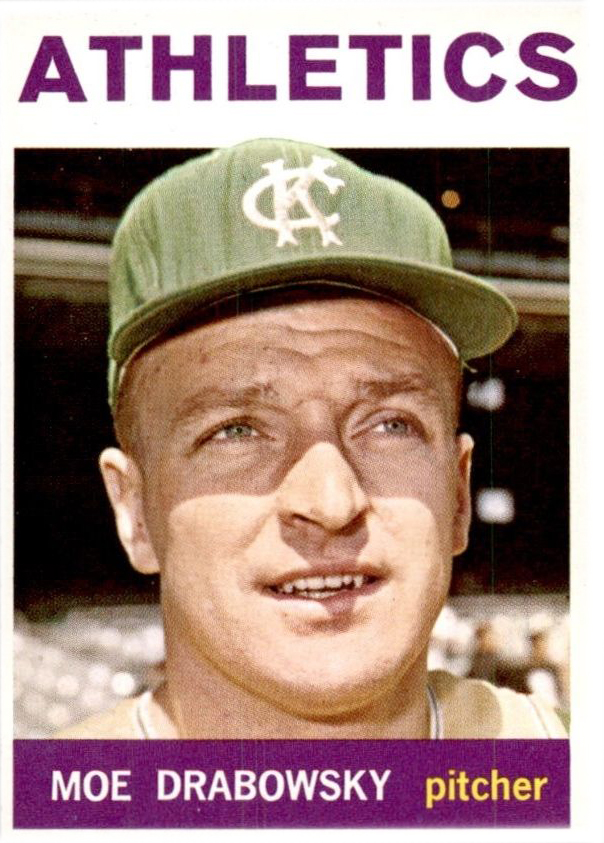
Drabowsky's disastrous AL debut


Uncommon commons: In more than 30 years in sportscards publishing I have thrown hundreds of notes into files about the players – usually non-star players – who made up the majority of the baseball and football cards I collected as a kid. Today, I keep adding to those files as I peruse microfilms of The Sporting News from the 1880s through the 1960s. I found these tidbits brought some life to the player pictures on those cards. I figure that if I enjoyed them, you might too.

After pitching for six and a half years in the National League, Moe Drabowsky came to the American League on Aug. 13, 1962, purchased by the Kansas City Athletics from the Cincinnati Reds.

Drabowsky (born Miroslav Drabowski in Poland in 1935), had been a bonus baby, signed by the Chicago Cubs in July, 1956, for a sum variously reported as $40,000-80,000.

With Chicago for five seasons he pitched with only moderate success, with a 32-41 record, before being traded to the Braves prior to the opening of the 1961 season. Milwaukee used him as a reliever and he was 0-2 after the first week of June, when he was sent down to AAA.

In the off-season, Cincinnati selected Drabowsky in the Rule 5 minor league draft. When he was 2-6 as a combination starter and reliever the Reds accepted a cash offer from the A's for Drabowsky.

American League teams teed off on Drabowsky from the get-go. I don't know if it's any kind of record, but in 28 innings over the rest of the season, Drabowsky was touched for eight home runs.

His AL debut on Aug. 18 in K.C. wasn't all that bad. He pitched in both games of a doubleheader against the Yankees. In the first game he held New York hitless in the 7th and 8th innings to help preserve a 5-4 win.  Called upon in the 5th inning of Game 2, with the A;s ahead 6-5, he gave up a home run to Clete Boyer to tie the score, being charged with a blown save in the 11-7 loss.

On Aug. 22, Drabowsky was the winning pitcher against the Boston Red Sox, 4-2, though in 7.1 innings he have up a pair of solo home runs, to Ed Bressoud and Gary Geiger.

The wheels really came off in his next appearance on Aug. 28 when he started against the L.A. Angels. With a 4-1 lead, he opened the top of the 4th inning by giving up back-to-back-to-back jacks to Lee Thomas, Leon Wagner and Buck Rodgers. Wags went deep on him again in the 6th. Drabowsky was pulled from the game and tagged with the 10-5 loss.

In his final six games for the A's in September, Drabowsky gave up just one home run, a three-run shot to Frank Malzone in a 12-4 loss at Boston.

Not surprisingly, the A's sent Drabowsky down to AAA Portland to start the 1963 season. When he was 5-1 with a 2.13 ERA, he was called back up to Kansas City in mid-June. By then, however, he had missed various Topps deadlines and he didn't have a baseball card in 1963.

Taking advantage of the new shoulder-to-knee strike zone, Drabowsky was able to hang around the major leagues for another 10 years, with the A's (through 1965), the Orioles (1966-68, 1970), the Royals (1969-70), the Cardinals (1971-72) and the White Sox (1972).

When the 1962 season closed, Drabowsky had given up a home run for every 3.5 innings pitched in the AL. For the season combined, his home run ratio was one per 5.29 IP. Overall, in his 17-season major league career, Drabowsky's averaged a home run surrendered every 9.02 innings.

Drabowky's lifetime big-league record was 88-105 with a 3.71 ERA. The highlight of his career came when he started Game 1 of the 1966 World Series, striking out 11 Dodgers in a 5-2 win to start the Orioles' four-game sweep of Los Angeles. 

Tuesday, November 10, 2015

Custom card for war hero Brian Stann


(UPDATE: A reader correctly informs me that the player photo I used on my original Brian Stann card (shown below) is not Stann; that midshipman is Eric Kettani. I've updated my card, as shown above.)

Ten years ago I made a 1955 Topps All-American style custom football card for former Sun Devil Pat Tillman. The honor (such as it is) was posthumous, following Tillman's death by friendly fire in Afghanistan.

I've now made a custom card for a living American war hero, Brian Stann.

Not being a follower of mixed martial arts fighting, I had never heard of Stann prior to seeing a feature about him on a preseason college football program. 

As I watched the story of this remarkable man, I knew a '55-style custom card was now at the top of my to-do list. 

It wasn't on the basis of his football career at Navy. Nor even because he was a bona fide combat hero of the Iraq War. The card certainly didn't result from Stann's success in the MMA ring and cage. The tipping point was Stann's on-going efforts for veterans as president and CEO of  Hire Heroes USA.

To learn for yourself why I've made a card of Stann, a good start can be had at his web site: http://www.brianstann.com/about.cfm .


Monday, November 9, 2015

Rodgers so good he gets two All-American customs


Did you ever wonder why NFL players doing their in-game "talking head" introductions on TV once in a while cite their high school, rather than their college, affiliation?

Is it because they hated their college coach and/or give greater credit to their high school coach for their success? Is it because they were dismissed from college? I suppose if you asked the players you'd get a myriad of reasons.

Aaron Rodgers sometimes introduces himself in those features as being from "Butte Community College," rather than the University of California. He has said that he does so because it was with Butte that he won his first football championship, in the NorCal Conference of the California Community College Athletic Association.

In recognition of his junior college success prior to starring for the Golden Bears at UC-Berkeley and embarking on a Hall of Fame career with the Green Bay Packers, I've created a second Aaron Rodgers custom card in the style of the 1955 Topps All-American college football set. Some years back I did a Rodgers '55AA custom with California.

This is only the second time I've done two '55AA customs for a player with two different colleges. Years ago I created different cards of Troy Aikman with Oklahoma and with UCLA, although those cards share a card number and back.


Thursday, November 5, 2015

My 100,000-mile milestone


On a quiet country road early on a recent morning, on my way to my retirement office, the odometer on my 2002 PT Cruiser turned to 100,000 miles.

These days, I guess that's not such a big deal. My daughter had a 1990-something Chevrolet Cavalier that had more than 260,000 miles before it was traded last winter.  With the advances made in automotive technology in recent decades, 300,000 miles is the new 100,000 miles.

This isn't the first car I've owned when it turned 100,000 miles. Thirty years ago I had a 1975 Cadillac Fleetwood that hit that milestone as I was pulling up to a local tavern. Coincidentally, the tavern was the same one that I once backed into with the Caddy as I was parallel parking . . . the sidewalk was very narrow and the Cadillac was very long. I'll mention that I hit the bar as I was going in, rather than coming out.

I had not owned the Fleetwood for all of its life, however. I bought it when it was 10 years old and had something like 60,000 miles on it. I don't remember how long I owned the Caddy after hitting 100,000 miles. I believe I sold it or traded it in in 1986 when I bought the first of a succession of custom vans.

The Cruiser, on the other hand, I have been the sole owner of these past 13+ years. I personally was behind the wheel for virtually all of its 100,000 miles.

I was an early fan of the PT Cruiser when it was introduced in 2001. I liked it's retro styling (my younger brother called it a "baby hearse").  In fact, my current Cruiser was the second I'd owned. In the car's inaugural year I bought a basic black example. Surprisingly, my wife suggested we should have 1950's style hot rod flames added; it really dressed up the car. My own personal touch was the addition of a decal of the Harvey Comics cartoon devil "Hot Stuff" on the rear hatch.

We had the black PT until late 2009 when we traded it in on a Dodge soccer-mom van more conducive to long-distance travel we were making by then between out seasonal homes in Wisconsin and Pennsylvania. The dealership immediately stripped off the flame decals before putting it on the lot. You can't account for taste.

By the summer of 2002 I was one year into recovery and rehabilitation of a devastating staph infection that had ravaged my right ankle. At the time I was still working and my daily driver was another 10-year-old Cadillac, a 1992 four-door Seville. 

I required a walker to get from my parking space to the office, where I used an electric wheelchair to get around. Getting in and, especially out, of the Seville was a serious challenge due to the low seat height. The PT Cruiser, on the other hand, has a seat height that was quite accommodating to my decreased flexibility.


Once again my wife was the agent of change. She came home one day in August and told me she'd seen a gold PT Cruiser on the lot of the nearby Mopar dealer. The next day we were in the showroom signing the papers on a 2002 Dream Cruiser, a limited edition of 1,500 with exclusive "Inca Gold" paint color.

To create something of a matched pair, I took the gold Cruiser to the same auto detailing shop that had applied the flames to the black car. They still had the template for the flames used on my black 2001, so I had them added to the new car. In place of the Hot Stuff decal on back, I had them add the figure of "Sparky," the mascot of the Arizona State Sun Devils, at the time one of my favorite college football teams.


Unfortunately, as it turned out, the decal material that was applied to my gold Cruiser was of inferior quality. Within six or eight years the flames had faded so badly I had them removed. Doubly unfortunate was that all areas of the flames that had been dark red had some sort of bad interaction with the Inca Gold paint and their removal left very striking bleached areas on the car. I had to have the hood, front fenders and both doors repainted to the tune of about $800 to restore the original finish.

I've been meticulous about maintenance of my Cruiser -- with the exception that I no longer buy into Big Oil's big lie that you should change oil every 3,000 miles.

I wouldn't be surprised if I'm still behind the wheel when my gold PT Cruiser turns 200,000 miles. I have not found many newer cars that have the seat height I like and the pedal clearance I need to accommodate the oversize boot I have to wear on my deformed right foot. 

My only major complaint with this car after 13 years and 100,000 miles is the gas mileage. For a relatively small auto, the gas consumption seems excessive; typically 22-25 mpg per tank in basically suburban driving,

For some years now, a photo of my gold PT Cruiser has been my icon on several of the hobby forums in which I participate. On the Collector's Universe forum, my user name is "AUPT". I don't expect t have to change those identifiers for some time to come.


Sunday, November 1, 2015

Custom '52T for Hall of Famer Sharman


Bill Sharman is a double-inductee to the basketball Hall of Fame, as a player (Washington Capitals 1950-51, Boston Celtics 1951-52 through 1960-61) in 1976 and as a coach in 2004.

You can read about Sharman's basketball career elsewhere on the internet. Here're a few of the highlights . . . 

Four-year player on USC Trojans after service in U.S. Navy during WWII. First team All-American in 1949-50.

Second round 1950 draft pick of Washington Capitols. Played there 1950-51. Selected by Ft. Wayne Pistons in dispersal draft 1951, traded to Celtics. Played 10 seasons with Boston 1951-52 through 1960-61.

Led the NBA in free-throw percentage seven seasons.

Played in eight consecutive NBA All-Star Games, 1952-53 through 1960-61.

Coached the Cleveland Pipers to American Basketball League championship in the league's only full season, 1961-62. Coached San Francisco Warriors 1966-67 and 1967-68. Coached Los Angeles Stars in the American Basketball League 1968-69 and 1969-70. Coached the Utah Stars to ABA Championship 1970-71. Coached L.A. Lakers to NBA Championship 1971-72.

Continued as Lakers coach through 1975-76 when he became the general manager through 1982.

Named to NBA 25th Anniversary All-Time Team, 1971. 

Named one of the 50 Greatest NBA Players in 1996.

Early in his professional career, Sharman had thoughts of being a two-sport major leaguer. He signed with the Brooklyn Dodgers for a bonus variously reported as $15,000-30,000 in 1950 and played five seasons in the Dodgers' minor league system. 

In 1950 he split time between two of Brooklyn's Class A farm teams, Pueblo and Elmira, hitting .288 with a dozen home runs.

After spending the 1951 season with AA Ft. Worth in the Texas League, batting .286 with eight home runs. Sharman was called up by Brooklyn in September. 

Manager Chuck Dressen intended to have Sharman spell the regular outfielders, particularly Duke Snider in center field, in the late stages of the pennant race and the expected run-up to the World Series.

However, things didn't go as planned for the team or for Sharman. 

When Sharman arrived in Brooklyn about Sept. 20, the Dodgers had surrendered most of what had been a 13-game lead in the National League as late as Aug. 11, and were in deep decline. Brooklyn was up by four games on Sept. 21; a week later they were tied with the Giants. Dressen needed to keep his regular players in the lineup and Sharman never got into a game.

In 1971 he recalled, "I was dying to get into a game . . . in the outfield, as pinch-hitter, anything. And five times, I almost did. Charlie Dressen called on me to pinch hit five times, But strange things kept happening. Before I could get up to the plate, somebody'd hit into a double play and end the inning, or somebody'd get picked off a base." 

It is part of baseball lore that while Sharman never got into a major league game, he did get thrown out of one. 

With tension running high and the Dodgers clinging to a one-game lead on Sept. 27 in Boston, a controversy erupted at home plate in the bottom of the eighth inning when Bob Addis scored on a fielder's choice to break a 3-3 tie. The resultant rhubarb precipitated the ejection of Roy Campanella and coach Cookie Lavagetto.  

When Sid Gordon grounded into a double play that would have ended the inning if the play at the plate had been called in Brooklyn's favor, the Dodgers' bench laid into home plate umpire Frank Dascoli once again. 

Dascoli ordered the Brooklyn bench cleared and the players were shepherded to clubhouse.

Technically, however, Sharman and the other Dodgers were not thrown out of the game; they were merely removed from the field. Wayne Terwilliger was called from the clubhouse in the top of the ninth to pinch-hit and theoretically, any of the other exiled Bums could have been brought into the game.

Brooklyn lost the game 4-3, cutting its lead to half-a-game and eventually leading to Bobby Thomson's dramatic walk-off home run to give the Giants the NL pennant in the one-game playoff on Oct. 3.

Sharman played the entire 1952 season at St Paul in Class AAA, where he hit a career-high .294 with 16 home runs.

He dropped to AA ball in 1953 with Mobile, hitting just .211 with 5 HR.

With his basketball career in full swing in 1954, Sharman decided not to play baseball. He later said that he felt year-round pro sports was putting too much of a strain on his legs and with seemingly little chance of making a go of it in major league baseball, he would concentrate on basketball.

He did return for one more minor league season in 1955, when the Dodgers placed him back at AAA St. Paul, where he hit .292 with 11 home runs.

While researching Sharman's baseball career for the back write-up on my 1952 Topps-style custom card, I ran into another bit of what I believe is unfounded lore related to Sharman's baseball career.

In several spots on the internet, it has been stated that Sharman was the first baseman on the USC 1948 team that defeated George H.W. Bush's Yale squad in the first-ever College Baseball World Series.

My admittedly cursory study of the official USC athletic sites and a few other places failed to turn up any confirmation of that claim. He's not listed on the Trojans roster before 1949 and the official team photo of the 1948 college championship team does not include Sharman.

Since he never played major league baseball, it's not surprising that Bill Sharman did not appear on any baseball cards. During his career as an NBA player, Sharman was on a pair of mainstream basketball cards, the 1957-58 Topps set and the 1951 Berk Ross multi-sport issue. By the time Fleer came out with its basketball set in 1961, Sharman was coaching. Sharman appears on a couple of dozen basketball cards issued since the 1990s.

When I originally conceived the idea of doing a 1952 Topps-style baseball card of Bill Sharman, I envisioned a horizontal-format card, based on one of the better contemporary photos of him in a Dodgers' uniform.

I later found what I consider to be a superior photo, and fortunately, it als lent itself to the horizontal format. 


Wednesday, October 28, 2015

Baseball snubbed Bobo's funeral


Uncommon commons: In more than 30 years in sportscards publishing I have thrown hundreds of notes into files about the players – usually non-star players – who made up the majority of the baseball and football cards I collected as a kid. Today, I keep adding to those files as I peruse microfilms of The Sporting News from the 1880s through the 1960s. I found these tidbits brought some life to the player pictures on those cards. I figure that if I enjoyed them, you might too.

While reading early 1963 issues of The Sporting News the other day, I found an item that baffles me.

I've been reading microfilm of TSN for nearly 10 years. I've completed the 1940s, the first half of the 1950s and the first few years of the 1960s. 

It has been my sense that throughout that period itinerant pitcher Louis  "Bobo" Newsom was a well-known, well-liked "character" in professional ball.

There weren't many issues in which you wouldn't find Newsom's name in connection with salary wrangle or a trade rumor. Perhaps he had been a favorite of the sporting weekly's editors or was oft-cited by the beat writers because he provided color to their columns.

What I read in the Jan. 5, 1963, issue of TSN, however, gives me pause to think that my assessment of Newsom's popularity has not been well-founded. 

In his Bob Addie's Atoms" column, Washington baseball writer Bob Addie reported just a month after Newsom had died on Dec. 7, 1962, that the only "baseball man to attend Bobo Newsom's funeral in Orlando was former teammate Sid Hudson."

Addie added, "And, incidentally, Newsom, who won 211 victories in his career, belongs in the Hall of Fame. He was colorful and he was courageous on that mound."

I don't think anybody today would stump for Bobo for the Hall of Fame. In 20 major league seasons between 1929-53, Newsom had a major league record of 211-222 and an ERA of 3.98.

Though he was a four-time All-Star, he led his league four times in losses. He sometimes also led in games started (4X) and completed (2X), as well as innings pitched, batters faced and other indicators of durability. 

No doubt, if he hadn't usually been pitching for second-division teams, Newsom's won-loss record would be much rosier.

Newsom came to the majors in just his second season in pro ball, at age 21 in 1929. Here's the summary of his major league travels:
  • 1929 Brooklyn Robins
  • 1930 Brooklyn Robins
  • 1932 Chicago Cubs
  • 1934 St. Louis Browns
  • 1935 St. Louis Browns
  •          Washington Senators
  • 1936 Washington Senators
  • 1937 Washington Senators
  •          Boston Red Sox
  • 1938 St. Louis Browns
  • 1939 St. Louis Browns
  •          Detroit Tigers
  • 1940 Detroit Tigers
  • 1941 Detroit Tigers
  • 1942 Washington Senators
  •          Brooklyn Dodgers
  • 1943 Brooklyn Dodgers
  •          St. Louis Browns
  •          Washington Senators
  • 1944 Philadelphia A's
  • 1945 Philadelphia A's
  • 1946 Philadelphia A's
  •          Washington Senators
  • 1947 Washington Senators
  •          New York Yankees (He won a World Series ring.)
  • 1948 New York Giants
  • 1952 Washington Senators
  • 1953 Philadelphia A's

Prior to, and in among, those major league stops, Newsom played in nine minor league seasons:
  • 1928 Greenville
  •          Raleigh
  • 1929 Macon
  • 1930 Macon
  •          Jersey City
  • 1931 Little Rock
  • 1932 Albany
  •          Reading
  • 1933 Los Angeles
  • 1949 Chattanooga
  • 1950 Chattanooga
  • 1951 Chattanooga

His minor league record was 131-106 on a 4.13 ERA.

My best wild-ass guess in that in all his travels, Newsom had 1,000 or so teammates and dozens of owners, managers, general managers, coaches, etc. In the Baltimore Orioles' inaugural AL season of 1954, Newsom hosted the team's Blue Ribbon (bread, not beer) Knot-Hole Club for kids and the pre-game television broadcasts.

You can read a good career bio of Newsom written by Ralph Berger for SABR at Bobo Newsom . The tone of that biography leaves me all the more puzzled about the lack of baseball's representation at his funeral.

For his 25+ years in pro ball, much of it in the heydays of bubblegum cards, Newsom was under-represented, at least so far as mainstream baseball cards.

His first issues were in 1936, when he appeared in Goudey's game-card set. That year he was also included in Goudey's "Wide Pen" and National Chicle's "Fine Pen" premiums.

In 1939 he was again in a Goudey premium set (R303-A). In the Gum Inc. 1941 Double Play set he is paired on a card with Tigers teammate Hank Greenberg.


His next card was in the Topps 1953 set. This is a memorable card from my childhood. While Topps (and Bowman) had a sprinkling of "old guys" in their card wars years of the early 1950s, most of the white-haired gents were managers or coaches, but the '53T recognizes Bobo as "Pitcher".

The real stumbling blocks to putting together a Bobo Newsom player set are cards on which he appears in 1954 and 1955 in the Esskay hot dogs Baltimore Orioles team sets. Even in typical wretched condition, those rare regionals can set you back several hundred dollars.

Besides baseball "cards" Newsom was included in a handful of team-issue photo pack issues such as 1948 Giants and 1940s-1950s Philadelphia A's.

In both 1960 and 1961, Newsom was included in Fleer's "Baseball Greats" issues. Since 1981, he can be found in eight or ten inexpensive collectors' issues.

Perhaps as I read deeper into the 1960s issues of The Sporting News I'll get a better feel for what, to me, is the mystery of baseball's snub of Bobo Newsom.

UPDATE:
Well, that didn't take long . . . 

In his column in the Feb. 2 issue, Addie reported receipt of a "gentle correction" from Tigers coach George Myatt, who also attended Newsom's funeral. Myatt indicated to Addie that there he saw "many baseball people" at the proceedings.

Sunday, October 25, 2015

'53T custom for long-time pro Quincy Trouppe


For a guy who played professional baseball all over the Western hemisphere nearly year-round for more than 20 seasons between 1930 and 1952, there are surprisingly few decent photos of Quincy Trouppe . . . and even fewer baseball cards.

All of Trouppe's career-contemporary baseball cards are Latin American issues and very tough to come by in today's hobby market. 

Since he played only six games in the major leagues, for Cleveland in 1952, it's easy to see why Topps, Bowman and other U.S. card companies omitted Trouppe.

I've recently completed a 1953 Topps-style custom card of Trouppe. It's based on a press photo I had for many years that was promulgated on the occasion of Trouppe becoming the first black man associated with the St. Louis Cardinals when they hired him as a scout in 1953. During his tenure as a Cards scout he is said to have recommended Ernie Banks and Roberto Clemente to the team, which rejected his advice.

Working up the back biography was not altogether an easy task. The internet resources that exist are not at all consistent concerning Trouppe's baseball travels and other biographical details.

Beyond my usual go-to resource, baseball-reference.com, let me recommend a pair of sites that I found useful in gathering data. James A. Riley's 1994 The Biographical Encyclopedia of Negro Baseball Leagues offers this: Trouppe bio. #1.

On the Laurens (Ga.) County African-American History blog in 2009, Scott Thompson posted this: Trouppe bio. #2.

I suppose a guy could use Trouppe's 1977 autobiography, 20 Years Too Soon: Prelude to Major League Integrated Baseball, to settle data disputes, but I've learned that you can't take what is written in such books as gospel, either. Still, I'm going to put the book on my winter reading list simply because I'd like to hear about this amazing athlete's career in his own words. 

Further complicating internet research is the fact that the ballplaying Trouppe had a son, Quincy Troupe Jr. (who spells the surname with only one p), who is an accomplished poet and writer. I spent a couple of hours working on an autograph element for the back of my card before noticing the spelling discrepancy. From various sources on the 'net I gather that Quincy Trouppe's surname probably started out as "Troup," the name of a prominent slave-holding family around Dublin, Ga. Shortly the "e" was added, and Quincy added a second "p" while playing in Latin America because he liked the way the locals pronounced it as "troo-pay".

While my custom card creation has slowed some in the past couple of months while I worked on disposing of my three-decades' accumulation of baseball cards and collectibles, with winter setting in I expect to increase my card output. Watch this blog for new releases.


Thursday, October 22, 2015

"Deacon" Law had rules for living a good life


Uncommon commons: In more than 30 years in sportscards publishing I have thrown hundreds of notes into files about the players – usually non-star players – who made up the majority of the baseball and football cards I collected as a kid. Today, I keep adding to those files as I peruse microfilms of The Sporting News from the 1880s through the 1960s. I found these tidbits brought some life to the player pictures on those cards. I figure that if I enjoyed them, you might too.

Part of Satchel Paige’s charm/mystique were the “rules” for life and baseball that he promulgated and that have been widely quoted since the 1940s.

Another player who formulated some thoughts on living a good life was long-time (1950-51, 1954-67) Pittsburgh Pirates pitcher Vern Law.

Law had been a three-sport high school star in Meridian, Idaho, and it was reported that he chose the Pirates from among a host of big league offers when team co-owner Bing Crosby phoned Law’s mother to assure her that Vern would be in wholesome environs with Pittsburgh.

An elder in the Mormon Church, Law spoke often to groups, using talking points from a notebook he kept with sayings and quick-quotes. He called them his “Words to Live By.”

Here are some of them, as reported by Les Biederman in in the March 13 issue of The Sporting News . . .

“I have never met a man who is not my superior at something.”

“A good timber never grows with ease; it needs a strong wind and storms to give it strength.”

“A discouraged man is not a strong man.”

“Don’t be satisfied with mediocrity.”

“There is nothing wrong with youth. Actually only ten per cent of the youths are bad and these ten per cent get all the publicity.”

Some of the rules by which the “Deacon” chose to live his life he summarized as . . .

“I shall never criticize my superiors. I will never uphold my opinion to the extent of angering another. I will never forget that I am one of God’s marked men.”

“I will always remember that I am made of the same stuff as the worst sinner and without God’s help I would be worse than he.”

“I will always have a smile for everyone, especially those who like me least.”

“When you are under the influence of anger and emotional outburst, growth is unlikely and spirituality impossible.”

“If you would rise to great heights, remember you cannot climb on the shoulders of your fellow men, but you must be worthy to be lifted by those about you to this lofty position.”

“There are two occasions in competition when you must learn to keep your mouth closed: When you lose and when you win.”

“A champion is not always a consistent winner; he may have been a one-time loser who would not quit. If you would leave footprints in the sands of time, it will be necessary to wear your work shoes.”

“Many have the will to win on the day of the contest, but few – the champions – have the will to prepare to win.”


Law’s words don’t have the folksy charm of Paige’s “Don’t look back. Something might be gaining on you,” but they speak volumes about the man who jotted them down.

Law won the Cy Young Award in 1960 with a 20-9 record. Some locker room horseplay after the pennant-clinching game in September led to his rapid decline thereafter.

A teammate tried to yank off Law’s shoe without untying the lace and accidentally twisted Law’s right ankle.

Adjusting his mechanics to accommodate the sore ankle, Law injured his right shoulder muscle. He went from a 20-9 mark in 1960 to a 3-4 record in 1961. After 1962-1963 seasons of 10-7 and 4-5, he went on the voluntarily retired list in August, 1963.

He returned for 1964, professing to suffer no pain in his shoulder, just weakness from lack of work. He was able to rebound to a 12-13 record.

Law pitched through the 1967 season, winning 48 more games and losing 36 to bring his lifetime major league record to 162-147.

4-hr. game most memorable
 
Though there were many highlights in his career, Law recalls an 18-inning no-decision game he pitched against the Braves in 1955 as his most memorable.

Law started the game at Forbes Field on July 19 at 8:15 p.m. and was still pitching at 2:35 a.m.

“It’s strange how that game stays with me through the years,” he said. “Fred Haney was our manager and I went 18 innings in a 2-2 game. I gave up nine hits, struck out 12 and walked two.

“We had a man on in the eighteenth, and when it came my turn to bat, Fred said he was going to send up a pinch-hitter.”

Roman Mejias batted for Law, with no success.

“We did not score and Bob Friend took over in the top of the nineteenth inning. The Braves got one run but we scored two in our half and won 4-3.”