Monday, October 31, 2011

Randy Moss custom completes my Second Series 1955 All-Americans

Since it now appears, with the 2011 NFL season more than half over, that Randy Moss is truly retired, I decided to go ahead and finish off my "Second Series" of 1955 Topps All-Americans.

I consider the 100 cards that Topps issued in 1955 to be the First Series. I picked up the process in 2003 with my first All-American custom card, Peyton Manning of Tennessee, which I numbered 101.

Now, 100 cards later, I have completed the Second Series. I have long since produced cards numbers after #200 (what I'm calling the Third Series), but I had been holding the last slot, card #152, in my Second Series for Moss, waiting for him to call it a career so I could write a "final" biography for the back.

Actually, writing the 90-or-so words for the back was one of the more challenging bios I've done. Love him or hate him, Moss had a brilliant college and NFL career.

Here in Wisconsin, there is more than average animosity towards Moss. He was an integral part of the Vikings teams that usually dominated the Green Bay Packers around the turn of the century.

Moss further enraged Packers fans on Jan. 9, 2005, when his 34-yard touchdown catch in the fourth quarter sealed a Vikings victory over heavily favored Green Bay in the Wild Card round of the playoffs. Moss poured salt in the wound in the end zone by pretending to drop trou and moon the Lambeau Field crowd.

Most of those who called for his suspension or expulsion from the league, if not his head, don't realize that Moss' mooning was a bit of an inside joke. For many years Packers fans have milled around the parking lot until the opposing team's buses pulled out after a game, then presented them with a moon en masse. The NFL fined Moss $10,000.

My 1955-style Randy Moss card is the first of perhaps half a dozen I'll create this winter, bringing me well into the Third Series.

Watch for them here.


Saturday, October 29, 2011

Standard Catalog Update: 1889 Tobin Lithograph Baby Talk Trade Cards

This is a listing that was prepared after thedeadline for the 2012 Standard Catalog of Baseball Cards. It was intended for a future edition, in the Vintage Major League section of the book.

1889 Tobin Lithograph Baby Talk Trade Cards

The “Baby Talk Series” that was cataloged as H804-1B in the American Card Catalog is a specific subset of a larger body of similar issues issued between 1887-1889.

The principal distinguishing feature of this set is the appearance at lower-right of a name associated with the ball-playing baby pictured. Even within this series, there are variations, such as some cards having a copyright notice in the bottom-right border, while some do not. All have the number “5” in the lower-left border.

The 3” x 4-5/8” color lithographed cards were originally sold with blank backs. Some advertisers chose to print messages on the backs, others overprinted their sales pitch on the fronts. Dozens of different advertisers are known to have used these cards as a medium.

Those cards that have name references to well-known players of the era King Kelly and Cap Anson, are more highly sought than the others.

Retail value for the Anson and Kelly cards are about $900 in Near Mint, $450 in Excellent and $275 in Very Good.

Values for the other cards average about $600 NM, $300 EX and $175 VG.


(1) Fee stykes, out. (Lord Fauntleroy)
(2) I’se a do’en home. (Baby Bunting)

(3) Oh, I dot it. (Kingdon Gould)

(4) Oh, I’se all’lite (Little Mascot)

(5) Oh, Mamma! (Baby Anson)

(6) Tan “oo” Tetch. (Baby McKee)
(7) Tum an Pay. (Mull Tobin)

(8) Tee-he-he! (Dixey, Jr.)

(9) Wow-ow! (Baby Kelly)


Thursday, October 27, 2011

Finishing Snider's Bowman run

I've completed my trilogy of Duke Snider custom cards with a creation in the style of 1955 Bowman.

Since his baseball card debut in the 1949 Bowman high-numbers, Snider appeared in every Bowman set through 1954, but he was absent from the final Bowman baseball set, the 1955 "Color TV" issue.

I think my version of a '55B Duke Snider card belatedly fills that void.

As of this posting, I have not yet printed the cards. I'm still dithering about which front to use. The smaller projection uses the background from the 1955 Bowman Frank Sullivan card. The larger projection repurposes the background of Brooks Lawrence's '55B. They are the same backgrounds I used in the two versions of my 1955 Bowman-style Sandy Koufax rookie customs.

The image of Snider swinging was lifted from an Upper Deck tribute card.

As football season is well under way, I really should be shifting my card-making efforts to some additions to my 1955 All-American updates and perhaps some other styles.

Keep watching this space for the results.

Tuesday, October 25, 2011

Standard Catalog Update: 1907 Cobb postcard

This is a listing that was prepared after thedeadline for the 2012 Standard Catalog of Baseball Cards. It was intended for a future edition, in the Vintage Major League section of the book.


1907 Detroit Seamless Steel Tubes Co. Ty Cobb Postcard

It is unclear whether this postcard of the budding Tigers star was a proprietary issue of a local steel company or a more generic postcard on which different advertising messages could be imprinted. The 3-1/2” x 5-1/2” black-and-white postcard has on front a full-length pose of Cobb, with a few biographical details. The back is pre-printed with postcard markings including a one-cent “stamp” and pictorial seal of the U.S.


Ty Cobb (Sold in 3/10 auction for $14,100 SGC-graded as Fair.)

Sunday, October 23, 2011

Standard Catalog Update: 1963-64 Pirates picture pack

This is a listing that was prepared after thedeadline for the 2012 Standard Catalog of Baseball Cards. It was intended for a future edition, in the Vintage Major League section of the book.


1963-64 Pittsburgh Pirates Picture Pack

This set of 5” x 7” black-and-white blank-back player pictures was created for sale at stadium concession stands and other souvenir outlets. The players are pictured in portraits or posed action photos, bordered in white. In the wide bottom border, the player’s name is printed in all capital letters, with the team nickname in upper- and lower-case letters. The set was sold in a white picture envelope. Because of the player selection, a specific year of issue cannot be pinpointed.

Common players in the set would have a retail value of about $4-5 in Near Mint. Mazeroski would be a $12-15 item, with Clemente at $40 or so.

Complete Set (12):
(1) Bob Bailey
(2) Smoky Burgess
(3) Roberto Clemente
(4) Roy Face
(5) Bob Friend
(6) Joe Gibbon
(7) Jerry Lynch
(8) Bill Mazeroski
(9) Danny Murtaugh
(10) Jim Pagliaroni
(11) Dick Schofield
(12) Bill Virdon

Friday, October 21, 2011

Standard Catalog Update: 1907 Providence Grays Postcards

This is a listing that was prepared after thedeadline for the 2012 Standard Catalog of Baseball Cards. It was intended for a future edition, in the Vintage Minor League section of the book.

1907 Providence Grays Postcards

While it is reported that this postcard issue for the Class A Eastern League Providence Grays includes 18 players, the checklist is not known, though it certainly includes many of the former and future major leaguers who were on the team. These might include Harry Lord, Rebel Oakes, George McQuillan, Joe Harris and Bill Abstein.

The black-and-white cards are in about the standard 3-1/2” x 5-1/2” postcard size, with typical markings on back. Fronts have posed player photos and a credit line to “Walford of the Tribune.” The cards were published by J.C. & C.H. Seddon of Providence.

                                 NM        EX          VG
Hugh Duffy          1,700.  850.00   500.00
Bob Peterson   250.00   25.00       75.00

Wednesday, October 19, 2011

Standard Catalog Update: 1938 Oakland Oaks stamps

1938 Signal Gasoline Oakland Oaks Stamps

This is the earliest of Signal Gasoline’s promotional efforts tied to their “home team” Oakland Oaks and the Pacific Coast League. The set features 24 black-and-white stamps in a size of about 1-5/8” x 2-2/3” that were designed to be placed into a 10-cent “Stamp Album and Autograph Book.” Each stamp features a player pose with his name and position in two lines in the bottom border.

                                                               NM       EX        VG
Complete Set in Album (24):       600.00 300.00 175.00
Complete Set, Singles (24)         500.00 250.00 150.00
Common Player:                             25.00   12.50      7.50
Album:                                            100.00   50.00    30.00

(1) Joe Abreu                                         
(2) Pat Ambrose                                    
(3) Al Browne
(4) Bill Conroy
(5) Jerry Donovan
(6) Ken Douglas

(7) Bob Gibson
(8) Jesse Hill

(9) Delbert Holmes

(10) Bob Joyce

(11) Hugh Luby

(12) Harry Martinez

(13) Wilcy Moore

(14) Floyd Newkirk

(15) Floyd Olds

(16) Bill Raimondi
(17) Ken Sheehan
(18) Hollis Thurston

(19) Geo. Turbeville
(20) Laurie Vinci

(21) Frank Volpi
(22) Jackie Warner

(23) Ed Yount

(24) “Dutch” Zwilling

Monday, October 17, 2011

Finally, a Duke Snider Giants card

My latest custom card is the second of what appears will be a trilogy of Duke Snider custom cards.

In the style of 1964 Topps, it pictures Snider with the San Francisco Giants, the team with whom he actually played in 1964. That was Snider last year as a player.

If Topps had scheduled Snider for one of the later series of 1964 baseball cards, he might have appeared as a Giant. But since he was slotted in at #155, in the set's second series, Topps had to run with a photo of Snider with the Mets.

After 16 seasons with the Brooklyn and L.A. Dodgers, Snider had been sold to the Mets just prior to the '63 season. He played 129 games for New York in 1963, the most in any season since 1957.

After just one year with the Mets, he was sold to the S.F. Giants on April 14, 1964. They released him after the season.

Snider rejoined the Dodgers' organization for 1965, as manager of their AAA Pacific Coast League team at Spokane.

I thought about making my Snider-Giants card in the 1965 format, to provide a career wrap-up with all of his MLB stats, but after kicking it around, decided to go with a 1964 style. In that era, Topps was never keen on issuing cards of players in the season after they retired,so that provided a good excuse to go with the 1964 version.

I also saved a lot of time using the 1964 format, since all I had to do is scan the back of a "real" 1964 Topps Snider and change the team name, logo and copyright information.

Saturday, October 15, 2011

Standard Catalog Update: 1957-62 Indians Picture Packs

Through the efforts of several dedicated Cleveland Indians collectors, we were able to assemble checklist information on a number of the 1950s-1960s Picture Packs issued by the team.

It was intended that these appear in the 2012 Standard Catalog of Baseball Cards, but production problems precluded that.

To assist in this presentation, I've eliminated the pricing data. In general complete sets in this era have retail values of $100-150 in Near Mint condition, with single pictures about $5 for typical players and $12-20 for Hall of Famers and local favorites like Rocky Colavito and Herb Score, wit the 1957 and 1958 Roger Maris at $25.


1957 Cleveland Indians Picture Pack

This set of “Official Autographed Pictures” issued in 1957 was sold at Municipal Stadium and other souvenir outlets for 50 cents. The player photos are in a 6-1/2” x 9” black-and-white, blank-back format with narrow white borders, printed on thin semi-gloss stock. About half the photos are identical to those issued in 1956. A facsimile player autograph on front identifies the photo.


Complete Set: (24)
(1) Bob Avila
(2) Jim Busby
(3) Alphonso “Chico” Carrasquel
(4) Rocky Colavito
(5) Bud Daley

(6) Kirby Farrell

(7) Mike Garcia

(8) Jim Hegan
(9) Ken Kuhn
(10) Bob Lemon
(11) Roger Maris
(12) Don Mossi
(13) Hal Naragon

(14) Ray Narleski
(15) Russ Nixon
(16) Stan Pitula

(17) Lawrence Raines

(18) Herb Score

(19) Al Smith

(20) George Strickland

(21) Dick Tomanek
(22) Vic Wertz

(23) Gene Woodling

(24) Early Wynn


1958 Cleveland Indians Picture Pack

This set of “Official Autographed Pictures” issued in 1958 was sold at Municipal Stadium and other souvenir outlets for 50 cents. The player photos are in a 6-1/2” x 9” black-and-white, blank-back format with narrow white borders, printed on thin semi-gloss stock. A facsimile player autograph on front identifies the photo. The players were pictured in their new striped uniforms.


Complete Set: (24)
(1) Bob Avila
(2) Bobby Bragan

(3) Dick Brown

(4) Alphonso “Chico” Carrasquel

(5) Rocky Colavito

(6) Larry Doby

(7) Mike Garcia

(8) Gary Geiger

(9) Jim Grant

(10) Bill Harrell
(11) Roger Maris

(12) Cal McLish

(13) Minnie Minoso

(14) Bill Moran

(15) Don Mossi

(16) Ray Narleski

(17) Russ Nixon

(18) J.W. Porter

(19) Herb Score

(20) Dick Tomanek

(21) Mickey Vernon

(22) Preston Ward
(23) Hoyt Wilhelm
(24) Indians Coaches (Red Kress, Bobby Bragan
        Eddie Stanky, Mel Harder)


1960 Cleveland Indians Picture Pack

A continuation of the team’s tradition of issuing player picture packs, this set of “Official Autographed Pictures” issued in 1960 was sold at Municipal Stadium and other souvenir outlets for 50 cents, in a black-and-gold paper envelope. The player photos are in a 6-1/2” x 9” black-and-white, blank-back format with narrow white borders. A facsimile player autograph on front identifies the photo.


Complete Set: (23)
(1) Ken Aspromonte
(2) Gary Bell

(3) John Briggs

(4) Hank Foiles

(5) Tito Francona

(6) Joe Gordon

(7) Bob Hale

(8) Wynn Hawkins

(9) Woody Held
(10) John Klippstein

(11) Harvey Kuenn

(12) Frank Lane (general manager)

(13) Barry Latman

(14) Mike Lee
(15) Bobby Locke
(16) Jim Perry

(17) John “Bubba” Phillips
(18) Jimmy Piersall

(19) Vic Power

(20) John Romano

(21) Dick Stigman

(22) George Strickland

(23) John Temple 


1961 Cleveland Indians Picture Pack

A continuation of the team’s tradition of issuing player picture packs, this set of “Official Autographed Pictures” issued in 1961 was sold at Municipal Stadium and other souvenir outlets for 50 cents, in a black-and-gold paper envelope. The player photos are in a 6-1/2” x 9” black-and-white, blank-back format with narrow white borders. A facsimile player autograph on front identifies the photo.


Complete Set: (22)
(1) John Antonelli
(2) Ken Aspromonte
(3) Gary Bell

(4) Walter Bond

(5) Mike de la Hoz
(6) James Dykes
(7) Tito Francona

(8) Jim Grant

(9) Wynn Hawkins

(10) Woodie Held

(11) Willie Kirkland

(12) Barry Latman
(13) Bobby Locke
(14) Jim Perry

(15) Bubba Phillips
(16) Jimmy Piersall

(17) Vic Power
(18) John Romano
(19) Dick Stigman

(20) John Temple

(21) Manager and coaches (Mel
        McGaha, Mel Harder, Jimmie
        Dykes, Luke Appling)
(22) Home of the Cleveland Indians 
        (Cleveland Stadium)


1962 Cleveland Indians Picture Pack

A change to a very thin paper stock with very little gloss marked the final Cleveland Indians picture pack of the era. This set of “Official Autographed Pictures” issued in 1962 was sold at Municipal Stadium and other souvenir outlets for 50 cents, in a black-printed manila paper envelope. The player photos are in a 6-1/2” x 9” black-and-white, blank-back format with narrow white borders. A facsimile player autograph on front identifies the photo.


Complete Set: (22)
(1) Bob Allen

(2) Gary Bell

(3) Ty Cline

(4) Dan Dillard

(5) Dick Donovan
(6) Howard “Doc” Edwards

(7) Chuck Essegian

(8) Tito Francona

(9) Frank Funk

(10) Jim Grant

(11) Gene Green
(12) Woodie Held
(13) Jerry Kindall

(14) Willie Kirkland

(15) Barry Latman
(16) Al Luplow
(17) Mel McGaha
(18) Jim Perry
(19) Bubba Phillips
(20) Pedro Ramos

(21) John Romano

(22) Manager and coaches (Ray Katt,
        Salty Parker, Mel Harder, Mel McGaha)


Thursday, October 13, 2011

Standard Catalog Update: 1929 Philly theater premiums


                                        1929 Lindy Theatre Philadelphia A’s
This is one of several theater giveaways of the era capitalizing on the A’s consecutive American League Championships of 1929-1931. This series is in a 3-1/2” x 5-5/8” black-and-white format. Fronts have a player photo with his name (in all-capitals) and position (upper- and lower-case) at lower-right. Backs have details of coming attractions at the movie house, generally aimed at youngsters. The extent of the checklist for this set is not yet known.

                                       NM       EX        VG
Mickey Cochrane     3,500.  1,750.  1,050.
Jimmy Foxx               6,500.  3,250.  2,300.
Bill Shores                3,000.  1,500. 900.00
Al Simmons              3,500.  1,750.   1,050.


1929 Orient Theatre Philadelphia A’s

This is one of several theater giveaways of the era capitalizing on the A’s consecutive American League Championships of 1929-1931. This series is in a 3-1/2” x 5-5/8” black-and-white format. Fronts have a player photo with his name (in all-capitals) at center. Backs have details of coming attractions at the movie house, generally aimed at youngsters. The extent of the checklist for this set is not yet known.


                                   NM          EX           VG
Jimmy Dykes        1,000.  500.00     300.00

Tuesday, October 11, 2011

Standard Catalog Update: 1888-1889 Giants Cabinets

1888-1889 Joseph Hall N.Y. Giants Cabinets
Among the several baseball related photographic cards produced by the Brooklyn studio of Joseph Hall was this series of individual player cabinets of the 1888-1889 N.Y. Giants. Approximately 4” x 6-1/4”, these cards were likely produced for sale to the public, though virtually every example known in the hobby today is unique. The card fronts have oval portraits of the players, with their name penned in below. In most cases the portraits are the same as those used on the S.F. Hess tobacco card set of 1889. The black-and-white backs of the cabinets have an engraving of Windsor Castle at top, with advertising for the studio below, all in an ornate border. This checklist is known to be incomplete.


                                  VG
Roger Connor     4,500.
Tim Keefe            4,500.
Jim O’Rourke      4,500.
Mickey Welch      4,500.


Sunday, October 9, 2011

Custom card: Duke Snider as an Expo

One of my favorite card show memories of the mid-1980s occurred at one of John and Wanda Marcus' Arlington, Tex., shows at which Duke Snider had been contracted as an autograph guest.

In the dealer hospitality room (I'll bet they don't have those at many card shows today) after the show closed on Saturday evening, Duke Snider strolled in, sat down and talked baseball for several hours.

Snider was a broadcaster with the Expos at the time. He was every inch the jovial "Silver Fox," and thoroughly captivated the baseball fans in the room. I had the chance to ask him about my then-favorite player, Expos catcher Razor Shines. I don't remember now what Snider had to say -- or, really, could have said -- about Shines, but I'll bet he tried his best not to cast him in any negative light.

Snider's appearance in the hospitality room that night stood in sharp contrast to how many, if not most, former major leaguers treated their card-show appearances in that era. Most guests wanted as little as possible to do with fan/collector interaction beyond what the terms of their signing contracts specified.

I guess that's why Duke Snider was among the most popular of the 1950s Dodgers, and remained so with an entirely new generation after his playing days. I believe his popularity will live on for a long while, even though he died earlier this year.

There was certainly no shortage of Duke Snider cards issued during and after his playing days. He appeared on Bowman cards every year from 1949-54, and on Topps cards 1951-52 and 1954-64. As a member of the popular Brooklyn and L.A. Dodgers teams of the 1950s, he also appeared on many regional card issues from Red Man tobacco to Dan-Dee potato chips, Briggs hot dogs, etc.

Snider's days as an Expos coach, however, are marked only by a pair of cards in the 1975 SSPC collectors' issue -- until now.

The latest in my series of 1970s-1980s coaches custom cards adds to Duke Snider's legacy. It is based on a photo from the Topps archives. I could have chosen to work up the card in either the 1974 or 1975 style, since Snider was on the Expos' staff both seasons, in between stints as a Montreal broadcaster.

The other choice I had, was whether to use the "Edwin D. Snider" facsimile autograph that appeared on his Topps cards between 1952-59, or go with the "Duke Snider" signature that appeared on his Bell Brand snack chip cards of 1959-1962. You can see which way I fell.

My to-do list contains at least two more Duke Snider cards, a 1955 Bowman and 1965 Topps. I'm not sure whether these cards will get done in the very near future, or if I'll be switching gears to work on some football cards first. Keep watching this space.

Friday, October 7, 2011

Standard Catalog Update: 1910 W-UNC Strip Cards

1911 W-UNC Strip Cards

Based on the selection of confirmed subjects, 1911 seems to be the best approximation for the issue date of this black-and-white, blank-backed strip card set. Similar in format and even typography to the set identified as 1915 W-UNC Strip Cards, the cards in this set were probably issued in a nominal 1-5/8” x 2” size, although significant differences in size are seen on the few known examples, possibly due to the manner in which they were cut. Fronts of the individual player cards have posed action photos with a black frame and bordered in white. Player identification is at bottom. The checklist here is certainly incomplete.


                                                      VG
Catcher Irwin (Emil Erwin)     1,600.
Hans Lobert                            1,600.
Christy Mathewson                 4,500.
Philadelphia A’s composite  2,250.

Monday, October 3, 2011

1940 Play Ball Superman ad back variations


I never collected 1940 Play Ball baseball cards, so it's not surprising I wasn't personally aware of the Superman ad back variations, but I am surprised that in some 30 years of cataloging cards I don't recall anybody else ever mentioning them.

I was recently contacted by reader Mike Guluzzi who had seen a 1940 Play Ball card being offered on an internet sales site that was being hyped by saying it "is the first known example of a 1940 Play Ball baseball card with the very rare Superman ad back."

Guluzzi said he went through his own holdings of 1940 Play Balls and discovered several cards with and without the mention of Superman. Specifically, he mentioned that he has card #159 Frank J. Snyder with and without the Superman ad back. His inquiry was about the range of the Superman backs and whether the hobby considers a 1940 Play Ball set to be complete with one or both types of backs. He also inquired as to whether there is, or should be, a price differential.

Having no familiarity with these variations, I made inquiry on a vintage card collectors' forum and got some quick answers.

All cards in the numerical range of #123-180 can be found with two backs. One back has the common promotional message at bottom on back, "A pictorial news record of America's favorite sport. Save these cards . . . know all about the game and its prominent players. New pictures every year."

Each of those cards, however, can also be found with one of six advertising messages for Gum Inc.'s Superman gum cards. For reasons unknown, cards #121-122, which were printed on the same sheet(s) as #123-180, are NOT found with Superman ad backs. Only one of the various Superman ads is found on any particular card.

(Editor's note: New information [Jan., 2015] shows that both cards #121 and #122 can also be found with the Superman advertising on back.)

More experienced collectors than I indicated that while the Superman version of any particular player's card is noticeably scarcer than the "pictorial record" version, premiums seldom rise to more than about 5-10% higher.

Most hobbyists would contend that a complete set of 1940 Play Balls would include just one each of cards #123-180, without regard to which back appears. A "master set," however, would require both versions of those cards.

These variations should be noted in future editions of the Standard Catalog of Baseball Cards.

Saturday, October 1, 2011

Brown damned with faint praise

Uncommon commons: In more than 30 years in sportscards publishing I have thrown hundreds of notes into files about the players – usually non-star players – who made up the majority of the baseball and football cards I collected as a kid. Today, I keep adding to those files as I peruse microfilms of The Sporting News from the 1880s through the 1960s. I found these tidbits brought some life to the player pictures on those cards. I figure that if I enjoyed them, you might too.

I don't know why it grabbed my attention, but something that I read in a late-1960 issue of TSN caught my eye.

It was a short mention of the Milwaukee Braves' purchase of back-up catcher Dick Brown from the Chicago White Sox on Nov. 28. I probably took notice because I don't remember Brown ever appearing on a baseball card with the Braves.

Turns out there was good reason for that . . . about a week after the Braves acquired Brown, he was traded to the Detroit Tigers along with Billy Bruton, Chuck Cottier and Terry Fox for Frank Bolling and (a year later, as "the player to be named later") Neil Chrisley.

Or maybe I took note of the transaction because of what TSN's Milwaukee beat writer Bob Wolf had to say about the purchase. Talk about being underwhelmed . . . Wolf wrote, "chances are that (Brown) will prove a thoroughly adequate No. 2 man to Crandall."

As it developed, the Braves were wise to be seeking a backup for their long-time star catcher; Crandall played only five games behind the plate for Milwaukee in 1961 due to an injured shoulder. The Braves filled the void by bringing up 19-year-old Joe Torre.

As a kid scouring wax packs in the 1950s and early 1960s for Braves' cards, it was always fun to see who Topps thought might be the next Milwaukee catcher. We enjoyed a parade of guys like Sam Calderone, Charlie White, Jack Parks, Bob Roselli, Del Rice, Hawk Taylor, Stan Lopata and Charlie Lau.

Another great line from Bob Wolf was found a couple of weeks later, in his account of the Dec. 15, 1960, trade of Braves' pitchers Juan Pizarro and Joey Jay to the Reds for Roy McMillan.  
Wolf described Pizarro and Jay as pitchers of "perennial promise."

Dick Brown had a nine-year career in the majors between 1957-65, batting .244 lifetime. He had only one season, 1962 with the Tigers, when he caught in more than 100 games.

Thursday, September 29, 2011

Newest custom: 1972 Larry Doby

I had planned to work on some custom cards while I was in the hospital for my knee replacement, but between being whacked out on painkillers the first couple of days, and rehab therapy the next few days, I never opened my computer.

Nevertheless, I have now finished my latest custom card, a 1972-style card of Larry Doby as an Expos coach.

I really enjoy seeing guys from my baseball cards of the 1950s-1960s (or earlier) as they would have appeared in the 1970s or 1980s as coaches, often in the uniform of teams other than those for whom they played.

I was never a particular Larry Doby fan during his playing days. No doubt as the first black player in the American League he endured many of the same hardships that Jackie Robinson did in the N.L.

Reflect, however, on the fact that Doby went directly from the Negro Leagues' Newark Eagles to the Cleveland Indians in July, 1947, just 11 weeks after Robinson's debut. Doby didn't have the benefit of a season of integrated baseball in the minor leagues of Organized Baseball that Robinson had.

Doby also didn't enjoy the instant success that Robinson had as a major leaguer. With the Indians in 1947, Doby hit just .156 in 29 games, striking out in 11 of his 32 at-bats. He also bounced around the Cleveland infield, playing at first base, second base and shortstop. 

Both Doby and Indians' owner Bill Veeck must have spent the off-season second-guessing their decision. That all became moot in 1948, however, as the Indians moved Doby to center field and he hit .301 to help clinch the A.L. pennant, then led all Indians' regulars, batting .318 to beat the Boston Braves in the 1948 World Series.

Doby batted only .125 in the Indians' 1954 Series loss to the N.Y. Giants, and, while he was a member of the 1959 Chicago White Sox for a couple of months in mid-season, he had been released to San Diego of the Pacific Coast League before the Go-Go Sox won the pennant and World Series.

Doby was one of the first former major leaguers to play pro ball in Japan, spending the 1962 season with the Chunichi Dragons of the Central League at the age of 38.

Continuing his international tour of pro baseball, Doby joined the Montreal Expos' organization in 1969 as a scout and minor league batting instructor. After managing Zulia in the Venezuela League in the winter of 1970-71, he joined the big club at Montreal as a coach, 1971-73.

While I could have chosen any style from 1971-73 for my Doby custom coach card, I ruled out '73 because he appeared in the regular Topps set that year as one of the coaches on manager Gene Mauch's card. Choosing the 1972 format over the 1971 style was really just a coin toss. Doing a '71 would have theoretically required having to dig up a second photo of Doby as an Expos coach to use on the back.

I'm OK with my choices on this one.

Tuesday, September 27, 2011

The Rockwell 'Post' cover that almost was

Among the 322 covers that Norman Rockwell produced for the Saturday Evening Post between 1916-63 were half a dozen baseball themes.

But the Rockwell baseball cover that "almost was" in 1952 would have no doubt been the most most popular with collectors.

As related in his column, "From the Ruhl Book," in the Jan. 23, 1952, issue of The Sporting News, Oscar Ruhl detailed the story of a cover painting that was intended for use on the Post around the time of the 1952 baseball season opener.

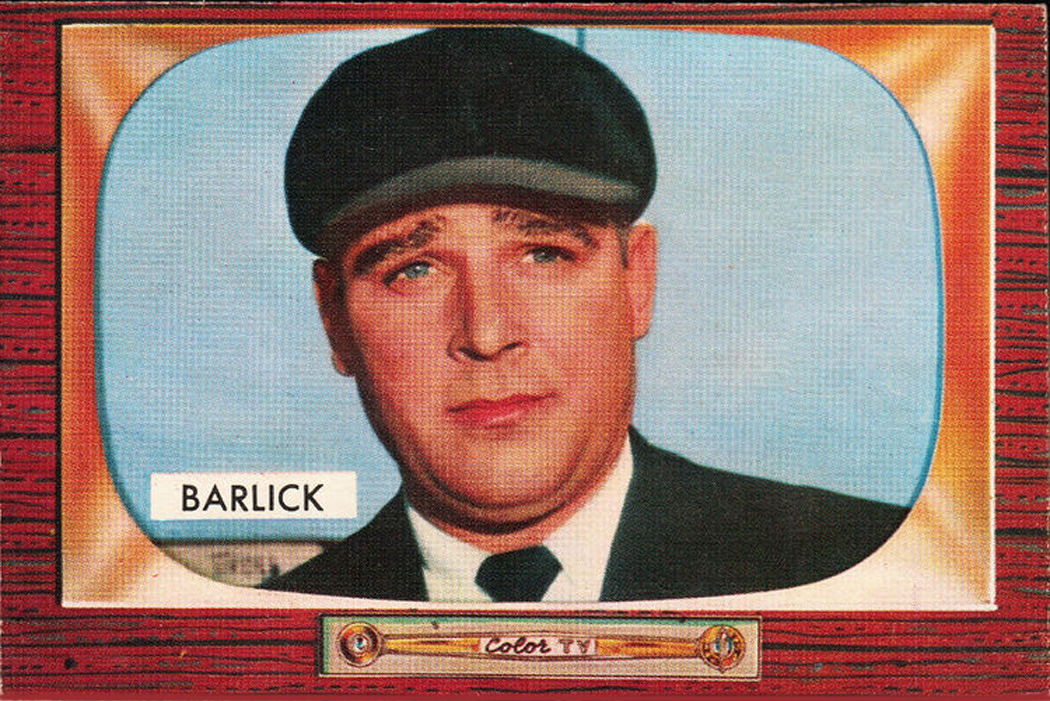
According to Ruhl, Rockwell had been commissioned to do a home-plate scene featuring Stan Musial, Joe Garagiola and umpire Al Barlick.

St. Louis residents Musial and Garagiola, and Barlick, who lived in Springfield, Ill., had spent three days at Sportsman's Park with the artist, posing for photos and sketches from which Rockwell would produce the final painting.

The cover was to show Barlick dusting off home plate with Musial in the batter's box and Garagiola, then a Pirates catcher, behind the plate. The problem was, to show Barlick's face in the composition, he had to assume a pose that was contrary to baseball custom.

Umpires were always taught to bend over to whisk the plate with their back turned to the pitcher's mound. If the umpire was facing the mound while he did his housekeeping, he'd be giving the fans behind home plate an up-close view (and target) of his backside.

Rockwell insisted that the cover art should show all three participants from the front, but when he submitted his preliminary painting, the Post's editors vetoed it because of its inaccuracy. There was no time to replace the painting in time for publication before the season opener (when, coincidentally, the Pirates were to meet the Cardinals in St. Louis), so what might have become a great collectible piece of baseball art never came to fruition.

As an aside, Stan Musial later did appear on a Post cover. On the May 1, 1954, issue, "The Man" is pictured signing autographs for a group of kids in a painting by John Falter, another frequent cover contributor to the popular weekly magazine.

Sunday, September 25, 2011

My customs on display at Ole Miss

I received a very gratifying email today from Oxford., Miss.

Last year, after he had seen some of my custom football cards on this blog, Langston Rogers, contacted me about displaying my four Ole Miss cards on campus. Rogers worked for nearly 30 years in the Sports Information Department at the University of Mississippi, until his retirement last year. Today he retains a retirement office at Ole Miss and the title of Senior Associate Athletic Director Emeritus.

Today, he sent photos of my cards on display in one of Archie Manning's cases at Hollingsworth-Manning Hall, which is the Ole Miss recruitment-memorabilia center where Rebels coaches huddle with recruits.  

I was a late-comer (mid-1980s) to Ole Miss fandom, so I'm honored to have my custom cards on display where they can be enjoyed by other fans and . . . who knows . . . maybe the next great Rebels star making a campus visit.

My quartet of Ole Miss customs are 1955 Topps All-American style cards of Archie Manning, Eli Manning and Michael Oher, and a 1952 Bowman-style card of Dexter McCluster.

How is it that I have not yet done a Chuckie Mullins card?

Friday, September 23, 2011

Gus Zernial's iconic '52 Topps card

One of the most memorable cards in the 1952 Topps baseball set is that of Gus Zernial (#31).

The smiling A's outfielder is shown holding a bat in his right hand. Attached to the bat are six baseballs. Actually, it is more likely that the balls were superimposed on the bat in a black-and-white photograph that was colorized for the Topps card. With his right hand, Zernial is making the "OK" sign.

While most collectors of Fifties cards know this image, few know what it represents. While it is spelled out on the back of the card, I'll summarize it here.

The photo immortalized on that card marks Zernial's tying the major league record for having hit six home runs in three successive ballgames.

On April 30, 1951, Zernial had been traded from the White Sox to the A's as part of a three-team, six-player deal. 

Two weeks later, on May 13, in the first inning of the second game of a doubleheader against the Yankees, Zernial hit his first home run of the year, off Spec Shea. In the fifth inning he homered again, off Fred Sanford. The hometeam Athletics beat the Yankees 9-6.

With the St. Louis Browns visiting Shibe Park for the next series, Zernial again homered twice on May 15. The first came against Dick Starr in the first inning. The second, in the ninth inning against Ned Garver, wasn't enough to overcome the A's deficit, and they lost 8-11.

The next day, the 16th, Zernial's home runs came against Duane Pillette in the second inning and Cliff Fannin in the fifth. The A's again lost, 9-10.

The '52 Topps card could have just as easily shown Zernial with seven balls on his bat, because on May 17, he homered again, off Don Johnson in the first inning, as the A's beat the Browns 7-6.

That home run also tied an American League record of seven home runs in four consecutive games. That mark had been set by Tony Lazzeri in 1936.

After his home run outburst, Zernial did not hit another for nearly two weeks, until June 2, but he went on to lead the American League in 1951 with 33 home runs and 126 RBIs.

Moreso because of the unusual photo than the player's star stature, the '52 Topps Zernial card has always enjoyed a modest premium over other cards in the low-number series.

Wednesday, September 21, 2011

Topps photogs foiled by Foiles

Uncommon commons: In more than 30 years in sportscards publishing I have thrown hundreds of notes into files about the players – usually non-star players – who made up the majority of the baseball and football cards I collected as a kid. Today, I keep adding to those files as I peruse microfilms of The Sporting News from the 1880s through the 1960s. I found these tidbits brought some life to the player pictures on those cards. I figure that if I enjoyed them, you might too.

Trying to get a current photograph of career back-up back stop Hank Foiles, Topps photographers were led on a merry chase in 1960-61.

That's because Foiles was the property of seven different teams in one year's time.

On Dec. 12, 1959, Foiles was traded from the Pittsburgh Pirates to the Kansas City A's, for whom he played the first half of the 1960 season. While that trade is reflected in the typography on Foiles' 1960 Topps card, he is still pictured as a Pirate on both front photos.

On June 1, 1960, the A's traded Foiles back to the Pirates, who had designs on sending him down to their AAA farm club at Columbus in the International League to bolster the team's catching corps.

Foiles, however, refused to accept the demotion and was given permission to seek a trade. On June 2, he was dealt to the Cleveland Indians.

Less than two months later, Foiles was traded to the Detroit Tigers, on July 26.

At the end of the 1960 season, he was placed on the roster of the Tigers' AAA team at Denver, then champions of the American Association.

In the Rule 5 minor league draft on Nov. 28, 1960, the Baltimore Orioles selected Foiles.

On his 1961 Topps card, Foiles is listed with the O's, but the photo shows him capless, in a Pirates' jersey.

On his 1962 Topps card, Foiles is finally listed with the same team whose uniform he wears -- the Orioles . . . but he never played for Baltimore that season, having been sold to the Cincinnati Reds on April 20.

Foiles' final two Topps cards show him with the correct and current teams, the Reds in 1963 and the L.A. Angels in 1964.

Hank Foiles played 11 seasons in the major leagues, mostly as a back-up catcher. He averaged just over 55 games a season, playing in more than 100 games only in 1957 and 1958 with the Pirates. He was a career .243 batter, but never hit more than nine home runs in a big league season.