Sunday, August 8, 2010

George Brett gets a 1974 Rookie Card


One of the advantages I have as a custom card maker in the 21st Century is the ability to "scoop" the old-time card companies with the advantage of 20-20 hindsight.
You certainly can't blame Topps for not including George Brett in its 1974 card set. In 13 games during his August-September call-up the previous season he had hit only .125 with no power.
But 35 years later, when an early image of Brett turned up on the internet (notice the uniform #25), I thought it would be fun to see how a '74 Brett would have looked.
Topps didn't use the All-Rookie Team trophy on any of its 1974 cards, but I thought it would make a nice additition to my custom and it nicely filled the space at the lower-left of the photo.
It had originally been my intention to do a 1973-style Brett card on the premise that he was going to make the majors with the Royals that season. But given his minor league stats, that would have seemed like quite a stretch.
In truth, I've never liked the 1974 Topps format and didn't like the 1973s much better, but as I worked on the '74, it kind of grew on me. Anyway, I've got a nearly complete 1973-style front and back template made, so if I ever want to make a card in that style, I'm halfway home.

Saturday, August 7, 2010

Player's son reports Globe '52 Dallas addition


Cataloging the early 1950s minor league baseball card issues by the Globe Printing Co. is a painstaking endeavor.

While we probably (I wouldn't bet the ranch ot it, though) have a record of every team that actually issued the cards, we don't have complete checklists for many of those teams.

In our Nov. 22, 2009 presentation, we ran a lengthy list of players' cards from the 1952 Dallas Eagles issue. The Eagles were a Class AA Texas League farm club of the Cleveland Indians in 1952. That checklist contained 21 cards, and we speculated that since it appears that Globe printed on six-card sheets, there were probably a few players missing from our list.

We've now got confirmation of one of those "missing" cards; it's pitcher Walt Lanfranconi.

That information comes courtesy of Greg Varhely, whose father, Edward, was also a pitcher on the '52 Dallas team. Greg had found our column while surfing the 'net for information about his dad's career. Among his father's effects were a pair of the Eagles' photo albums and a stack of the Globe player cards.

Lanfranconi was the only card that wasn't in that legacy. Lanfranconi was a Vermont native who, except for World War II service in 1943-45, played pro ball from 1937 through 1953, usually at the Class AA or AAA minor league level. He also pitched in the majors, going 0-1 with the Chicago Cubs in 1941 and 4-4 with the 1947 Boston Braves.

Greg had sent scans of all of the '52 Globe Eagles he has. They are a good looking group of cards, generally featuring posed-action photos.

The back cover of the album indicates that the player cards were to be given away at "special photo nights throughout the season." That seems to have been typical of the Globe minor league cards, which explains why complete sets of most teams are virtually unknown.


Wednesday, August 4, 2010

Another alternate Indians picture pack. 1949?


On May 23 we presented a 1950 Cleveland Indians picture pack that differed from the long-cataloged picture pack in that instead of "facsimile autographs" the players were identified by a relatively thcik black or white script name.

The pictures otherwise followed the format used by the Tribe for its souvenir picture packs between 1947-1956. The pictures are blank-backed, 6-1/2" x 9" with players represented in either portrait or posed action photos.

We now learn, from veteran vintage collector and Standard Catalog of Baseball Cards contributor Rhett Yeakley that this type of alternative photo pack was also issued earlier, probably in 1949.

That dating is empirically based on the player photos in his possession. Yeakley has 15 pictures of what would typically be 25-30 in a contemporary Indians' picture pack. His line-up is:

  • Gene Bearden
  • Ray Boone
  • Lou Boudreau
  • Allie Clark
  • Bob Feller
  • Mike Garcia
  • Joe Gordon
  • Steve Gromek
  • Jim Hegan
  • Dale Mitchell
  • Frank Papish
  • Satchel Paige
  • Thurman Tucker
  • Mickey Vernon
  • Sam Zoldak
Papish and Vernon were not with the Indians in 1948, so if this group represents a single issue -- and differences in picture stock on some of the players make that a big "if" -- the date of issue narrows to 1949.

Yeakley notes that two of his pictures are on paper stock that it thinner and not textured, whereas the other 13 pix are on the thicker, textured paper associated with many of the Indians' other photo pack efforts in the 1940s and 1950s. The two outliers are Mike Garcia and Ray Boone.

Yeakley also notes that the picture of Gene Bearden in this "set" is a portrait, while the Bearden photo that was pictured in our article about the 1950 set was an action pose.

Since it is likely that the pictures in Yeakley's possession share at least some of their poses with the earlier-identified 1950 set it will be hard to pin down a checklist for a specific 1949 sisue unless a complete-with-envelope set is brought to our attention. It is, however, good to know that the Cleveland "wide pen" team-issued photo packs were more than a one-year phenomenon.

Saturday, July 31, 2010

Bobby Layne custom card 2.0 and 3.0


I'll admit it, I'm too anal about my custom card creations. (I'm also one of those people who believes that if you confess to a personality fault, you don't have to do anything to correct it.) That's why my "update" series of 1955 Topps All-American-style college football cards will never be complete.

Even if I worked my to-do list and my wish list down to nothing, I'd still be compelled to go back and re-do some of my earlier cards. I've been at this series for almost seven years, and some of my earlier creations leave a but to be desired. It's a combination of settling for what I now recognize are substandard player photos in the early days, and the fact that I was a rank novice in terms of Photoshop.

As my technical skills have improved, so has my eye for what will or will not make a suitable card image.

In the back of my mind I have a list of those among my 125+ cards in the 1955 format that I am not altogether satisfied with. With the completion of a new (and newer) Bobby Layne card, that list of rehabilitation projects is one card shorter.

As you can see from my first attempt (the top card), the player photo is merely OK. My recollection is that it came from a book. Thus it started out low-resolution and didn't improve when enlarged a bit for my card. The colorization of the black-and-white image also left something to be desired. Layne's hair is too yellow and . . . I'm unsure why . . . the numerals on his jersey are the wrong color, at least according to the majority of color images I've found on the web.

So, when a press photo of Layne showed up on eBay a while back, I jumped at the chance to improve upon my first version. The initial result, Bobby Layne version 2.0, is in the center above. I spent a Saturday afternoon working on cleaning up and colorizing the press photo, and working it into my '55 design. Everything looked fine on the computer screen, but after I had printed out the front, I began to have second thoughts.

Do you see the problem? In the size to which I cropped the photo, Layne's "package" seems to just jump off the card at the viewer. In the case of Bobby Layne, one of the hardest-living NFL players or his era, that's probably not an altogether out of synch image. Layne is one of the persons whom I quote most often. He once said that it was his life's ambition to run out of breath and money at the same time. Nonetheless, I decided that since I hadn't yet cut and pasted the image into actual cards, I'd take another stab at it.


The result is the third card in the stack shown here, Bobby Layne version 3.0. That one I can live with.


Tuesday, July 27, 2010

My 1955-style Mark Harmon gets a remake


Not long after I created my first 1955 Topps All-American style custom card of Peyton Manning in 2003, I decided that my long-term goal would be to equal Topps' output and create an "Update" set of 100 cards.

My intention was to make cards in that classic format for players who either hadn't made the original Topps cut in 1955, or who weren't yet playing college ball then (in many cases, the players on my cards hadn't been born yet in 1955).

In the early days of my project I actually wondered whether or not I'd be able to find 100 suitable subjects. That fear soon dissipated as my to-do list grew and grew. Today I have completed 122 cards in the '55 AA style and have my sights set on many more.

Actually, my "Second Series" is not yet complete. I'm holding card #152 for Randy Moss. I have some nice pictures of Moss in his Marshall playing days, but am holding off on doing the card until he retires.

This is all by way of explaining that some of my earlier efforts, in an attempt to fill out my checklist, weren't always of the highest quality. I was so concerned with getting to 100 cards that I sometimes worked with substandard photos. The result was, naturally, cards of which I'm not particularly proud.

One such was my first attempt at a Mark Harmon card. Harmon is, of course, best known to most for his years as the star of NCIS on CBS since 2003. But he was also UCLA's starting quarterback in the early 1970s. Harmon's father, Tom, appeared in the original 1955 Topps All-American set as Michigan's Heisman Trophy winning halfback of the late-1930s.

A look at my All-American Update checklist reveals several current and former TV and movie stars who played college football; it's a recurring theme of my collection. If I had not already made a Mark Harmon card, though, it would be quite far down my list of cards to create. I've just never had a fan connnection with him and, in fact, have never watched more than a couple of minutes of any NCIS episode.

Nevertheless, since I did make a Mark Harmon card, and since it did turn out to be less than my best work. I've been on the lookout for a better photo with which the rework the card. At this point, I don't even remember where I got the photo that appears on my original version. It's blurry and you can't really tell who it is under that helmet.

Thus, I was quite happy to find, while browsing around the internet a few weeks ago, a much more suitable photo of Harmon as a Bruin. As it is a press photo, it required colorizing, but that isn't usually much of a challenge.

I think you'll agree that the new version of my Mark Harmon card is a significant upgrade from the original.

Friday, July 9, 2010

Roman Gabriel added to my '55-style set

I've finally added a Roman Gabriel card to my checklist of 1955-style All-American football cards. But it wasn't easy.

I've always had Gabriel on my mental to-do list for the project, but had never run across a useable college photo. The Rams were always among my Top 5 favorite NFL teams in the 1950s and early 1960s, and when Gabriel finally got off the bench and became a starter, he became a player of more than moderate interest to me.

Maybe it was because he was the NFL's Joe Namath before there was a Joe Namath. He was literally tall, dark and handsome (he was once described as the "world's biggest Filipino) and his long hair made him stand out from the establishment quarterbacks like Johnny Unitas and Bart Starr, with their crewcuts. To a rebellious teen-ager (at least as rebellious as you could be in the mid-Sixties when you're white, middle class and living in a small Wisconsin city) who hadn't yet been brainwashed to hate pro football as a metaphor for The War, Gabriel was a player whose career I followed for a time.

I thought I'd struck paydirt in my card quest when I discovered Gabriel was included in the photo spread for Playboy's All-American team in the magazine's annual Pigskin Preview issue in 1961. I bought a copy on eBay for six or eight bucks, but when I got the magazine in hand, my hopes were dimmed considerably.

Creating a custom card from a magazine photo is always dicey. I knew from the preview I'd seen on line that Gabriel's image in the group photo was going to be small. It also turned out to be a bit fuzzy upon enlargement and the color printing was somewhat out of register. I diddled the image for a couple of hours last weekend, then plopped it onto the card's background. I didn't like the result (shown at left).

Another hour searching the internet for a suitable image didn't turn up anything useful; everything was either too small or too low-res. Fortunately, the search turned up an image of the cover of the 1961 NCAA record book, with an action pose of Gabriel.

An eBay browse offered my choice from among a handful of copies. Most were priced in the $15-25 range, which is more than I like to pay for the materials I use. I spotted a copy that had some items clipped from the interior pages and my low-ball offer was quickly accepted.

I was able to colorize the black-and-white cover photo and achieve an acceptable result, the image shown here at top.

As is almost always the case, boiling down the copy for the back of the card to about 90 words was a challenge. Even though he never won an NCAA Championship or a Super Bowl, Gabriel had a great career and has led an exemplary life.

He was a three-sport star in high school and after sifting through college scholarship offers, elected to stay in his native state at North Carolina State. While he played freshman basketball and varsity baseball (a slugging first baseman, he once hit three home runs in a game), eventually he came to focus on football.

Even though the Wolfpack was mediocre during his three seasons as quarteback (11-18-1 from 1959-61), he caught the pro scouts' eye. He was both All-American and Atlantic Coast Conference Player of the Year in 1960 and 1961, and was academic All-American in 1960. He completed 285 of 506 passes in his collegiate career, for 2,951 yards. He threw for 20 touchdowns and ran for 15. During his days at N.C. State, his fans developed a new Wolfpack fight song, "Throw, Gabriel, Throw."

The Oakland Raiders made Gabriel the No. 1 overall pick in the 1962 AFL draft, while the L.A. Rams chose him with the No. 2 pick in the NFL draft. Back in those heady days of NFL vs. AFL bidding wars, Gabriel's football fortune was assured. He signed with the Rams, but later said that's because while he was being "baby sat" in a hotel room by the Rams' Elroy Hirsch, a phone call from the AFL with a $100,000 offer was intercepted by Hirsch, who being mistaken for Gabriel's agent, assured the upstart league that Gabriel was firm in his desire to play in the NFL.

Gabriel was among the firsy of the "big man" quarterbacks in the NFL, at 6'4" and 235 lbs. He had an incredibly powerful arm and took the Rams to two NFL Championship games. He was a four-time Pro Bowl selection and was league MVP in 1969. Plagued by knee and shoulder injuries, he went to the Philadelphia Eagles in 1973, when he was named Comeback Player of the Year, and retired after the 1977 season.

As a starting quarterback in Los Angeles, and given his physique and dark good looks, it was natural that Hollywood came calling. He played an unnamed prison guard in the 1968 LSD film trip Skidoo, and had his biggest role as John Wayne's adopted Indian son Blue Boy in the 1969 Western, The Undefeated, which also included in the cast teammate Merlin Olsen. He had a number of television appearances, including as a headhunter on Gilligan's Island, and also appeared in the Raymond Burr series Perry Mason and Ironsides.

Gabriel did some assistant coaching in the USFL with the Boston Breakers and Arizona Wranglers, and in the World League of American Football in 1991-92 was head coach of the 0-10 Raleigh-Durham Skyhawks.

Though slowed by a stroke in recent years, Gabriel has devoted enormous time and energy since his football days to raising money for charities in and around North Carolina. I'm glad I was finally able to add him to my checklist of '55-style college custom cards.


Friday, July 2, 2010

"Road show" turns up 1950s record set


Last Sunday I was part of the appraisers' panel for a "road show" type of event in conjunction with the Iola Historical Society's summer fund raising day.

Iola, being the home of what was once the world's premier publishing company for collectors and hobbyists, has many resident experts in virtually every collectible area. The historical society offers an appraisal service where for $3 the general public can have experts give a verbal evaluation of their attic treasures.

I've been involved with this for the past three years; working, naturally, at the sports cards and memorabilia table. The event never draws a really big crowd, and at least at the sports table, we've never seen anything really valuable, but it is a fun way to spend an afternoon and to catch up with former colleagues (I share the sports table each year with SCD editor T.S. O'Connell) and to meet some interesting people.

I had a nice conversation, for instance, with an elderly gent who brought by a small picture frame with a pair of ticket stubs from the 1938 University of Wisconsin football season. The tickets were from games with Marquette (back whe n that Milwaukee school had a football program) and Pittsburgh. The tickets have a great art deco look and the price of 25 cents for a seat at a Badger game was a real blast from the past.

The old guy was in high school when he attended those games and has been to at least one Wisconsin game every year since. He had no interest in selling the tickets but was interested in their value, and even more interested in talking about 70 years of college football. My ballpark guesstimate was $50 apiece.

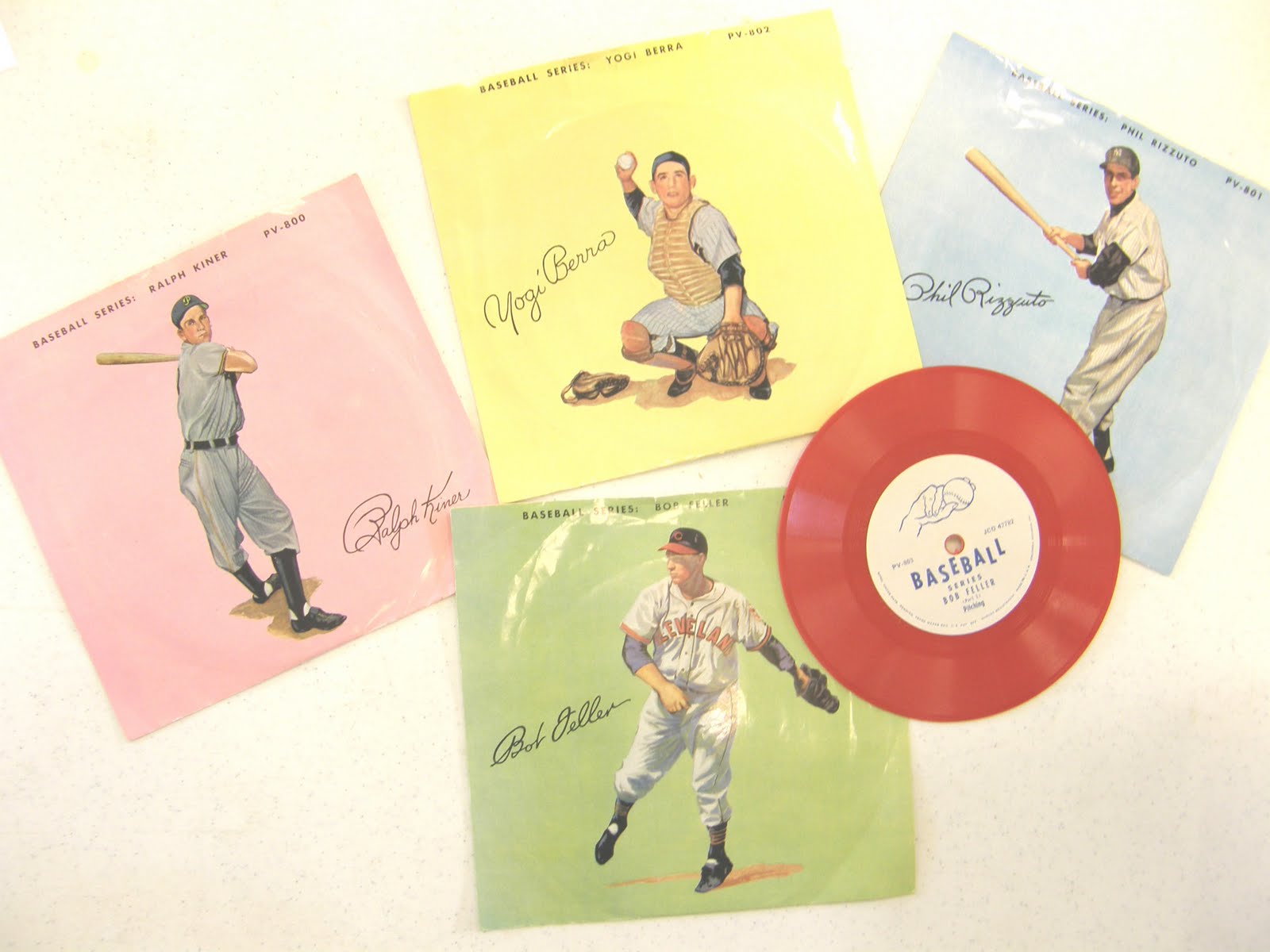
Our first appraisal for the day is presented here. A middle-aged fellow brought in a quartet of baseball instructional records.The value of such records within the cards/memorabilia hobby is usually in the quality and condition of the picture sleeves, rather than in the records themselves.

Over the years when working for the Standard Catalog of Baseball Cards and elsewhere in the hobby, I'd seen several issues of instructional records from the 1950s through the 1970s. This particular grouping was not one with which I was familiar.


The records are 6" diameter, pressed in red plastic with rather plain paper labels. The small central spindle hole identifies them as 33-1/3 or 78 rpm. Presumably the content of the record consists of the player providing playing tips for his position.

The front of the picture sleeves displays great top-to-cap artwork of the players in action poses against a bright pastel colored background. Black-and-white backs are truly ugly, with crude drawings. Columbia records is identified in a couple of places on the sleeves and records as the maker.

When I viewed the player selection, I thought these might have been a Wheaties premium, because the four players represented were all included in several early 1950s Wheaties promotional items. The records' owner said he did not remember where he had gotten the records, and that they may have been some sort of cereal mail-in premium.

Since neither T.S., nor I . . . or even the event's record expert . . . had seen these before, we weren't able to provide any definitive answers, but I promised the owner I'd do some poking around the internet and get back to him. On the basis of what similar records sell for, I told him I thought the set of four -- Yogi Berra, Bob Feller, Ralph Kiner and Phil Rizzuto -- in the rather nice condition in which they were preserved, should be worth about $200.

The records were numbered PV-800 through PV-803, so I postulated that four pieces might comprise the complete issue, though if they were a Wheaties promotion, it is possible other regulars from the Wheaties line-up such as Stan Musial, George Kell or even Ted Williams or Jackie Robinson, might have been issued.
It turned out that finding information on the records was easy once I got to a computer. The records were actually included in a new products article in the June 2, 1952, issue of Time magazine. I was correct in that Berra, Feller, Kiner and Rizzuto represent the complete set, but there was no mention of any connection with Wheaties or any other sponsor. The article mentioned that the "unbreakable" records retailed for 34 cents apiece.

A little bit of digging on eBay turned up current or recent sales of each of the records, except for Berra. In a condition in which the picture sleeves were generally in about VG condition, as opposed to the EX or so condition of the set that I had viewed, the records had sold for $20-40 apiece.

Given that Berra would be the highest priced among the group, I'm confident my $200 appraisal for the set of four in that condition was fairly accurate. If there had been a Wheaties connection and identification on the records, I think he value would be 25% higher.

I shared my findings with the records' owner, and now I've shared them with you.


.


Wednesday, June 30, 2010

Joe Guyon, Part II, the pro years

As promised in my June 28 posting, I’m here to wrap up the story of Joe Guyon, with a recap of his career as a professional football and baseball player in the 1920s. If you haven’t read the first part, I’ll wait here while you get caught up.
Guyon left college in 1919, at the age of 26 (eligibility standards were different then), accepting Jim Thorpe’s invitation to join the Canton Bulldogs, a professional football powerhouse in the Ohio League, which was a direct ancestor of today’s NFL.
With a 9-0-1 record, Canton won the 1919 league championship. In 1920, Canton became a charter member of the American Professional Football Association, which became the National Football League in 1922.
In 1920, Guyon, Thorpe and the Bulldogs finished eighth, at 7-4. Unfortunately, stats for the NFL’s early seasons are not available, so it is impossible to quantify Guyon’s performance or make valid comparisons to other pioneering pro stars. We do know, however, that he is credited that season with a 95-yard punt.
Guyon remained paired with Thorpe in four more NFL backfields between 1921 and 1924. They played with the Cleveland Indians in 1921, the Oorang Indians (a traveling team of Native Americans sponsored by a championship dog breeder) in 1922-1923 and the Rock Island Independents in 1924. Surprisingly, those teams had a combined NFL record of 12-23-2, with only one winning season, a 5-2-2 record at Rockford. The two were also close off the field, with Guyon serving as best man at Thorpe’s wedding.
Some sources indicate Guyon also played with the APFA Washington Senators and the independent Union Quakers of Philadelphia in 1921, though those affiliations are not mentioned in Guyon’s official NFL Hall of Fame biography.
Thorpe and Guyon’s football paths diverged in 1925, Thorpe remaining at Rock Island with Guyon moving on to the Kansas City Cowboys in 1925, suffering another losing (2-5-1) season.
If he played pro football at all in 1926, Guyon played for independent teams. In 1927, in their third year in the NFL, the New York Giants signed Guyon. Playing guard tackle, blocking back and tailback and doing the punting, Guyon helped the Giants to an 11-1-1 record and the NFL Championship. “I did everything except sell programs,” Guyon said.
Guyon’s engagement with the championship Giants was his last in the NFL. Though not yet 35, it was reported that a baseball injury prevented his return to pro football. He was inducted into the Pro Football Hall of Fame in 1966.
Prior to joining the Canton football team in 1919, Guyon was reported by The Sporting News to have been playing independent baseball in Minnesota and North Dakota. He was given a trial by the New York (baseball) Giants late in the 1919 season, but failed to make the club and, though he played minor league ball for 12 seasons, never played an inning of major league ball.
Late in 1919, Guyon signed his first pro contract with the Atlanta Crackers of the then-Class A Southern Association. The Sporting News’ Atlanta correspondent, who wrote under the by-line of Lynch, lauded what he called the surprise move by team owner Charley Frank to acquire “Georgia’s star football and baseball player.” Lynch wrote, “Although it has been known locally that the popular college player would sign with some professional team for the 1920 drive, it was believed here the offers of several major league clubs, known to have been made to him, would prove so successful that efforts of local magnates to secure his services would prove futile.”
Guyon traveled a bit during the 1920 season. He book ended the season with Atlanta. Early in the year he was put on waivers and claimed by Little Rock. He was joined on the Travelers, who were also a Southern Association team, by Native American players William Wano and Moses Yellow Horse. In July, Guyon was put on waivers by Little Rock and Atlanta reclaimed him.
Guyon initially refused to report back to Atlanta and played for a time with Winder in a Georgia outlaw league. By the end of the season he was back in Atlanta. The SABR Minor Leagues Data Base shows Guyon also found time to play a handful of game in 1920 with Augusta, of the Class C South Atlantic League. Overall, Guyon’s batting average for 1920 was just .233 with one home run.
For the off-season, Guyon joined the Georgia Tech football coaching staff, reportedly commuting each weekend to professional engagements with Canton.
Guyon spent the 1921-1923 season in Atlanta’s outfield. He hit .309, and once the lively ball made its way to the Southern Association, his home run output jumped to 11 in 1922 and 10 in 1923. He had never previously hit more than one home run in any season.
Speed was Guyon’s principal weapon. He stole more than 200 bases in his minor league career, including 45 with Atlanta in 1921. Four times he scored more than 100 runs.
It was back to Little Rock for Guyon in 1924, where he hit .346. He spent the 1925-28 seasons with Louisville, batting a nifty .350 and helping the Colonels to American Association championships in 1926 and 1927.
He played only 25 games for Louisville in 1928, injuring his knee when he ran into an outfield fence in May. That ended his hopes of making the major leagues, as well as his pro football career.
From 1928-1931, Guyon was head baseball coach for the Clemson Tigers, with a combined 42-36-3 record.
In 1931, Guyon returned to professional baseball at the age of 38 as a playing-manager for the Anderson/Spartanburg Electrics of the Class D Palmetto League, batting .315. He jumped a couple of classifications in 1932, managing Asheville of the Piedmont League (Class B). He hit .364 that season in 66 games.
In the off-seasons, Guyon coached high school football at St. Xavier in Louisville from 1931-33, with a 16-7-2 record. Guyon’s final engagement in pro ball was as playing-manager of the Fieldale Towlers in the Bi-State League, a Class D circuit in Virginia and North Carolina. At the age of 43 he was still able to hit .265 in 33 games.
Overall in 12 minor league seasons, Guyon hit .329.
Following his playing days, Guyon lived for a time in Harrah, Okla., and from 1954-1962 in Flint, Mich., where he was a bank guard. A fellow Georgia Tech alum who knew Joe Guyon after his playing days, Joseph P. Byrd III, said of Guyon, “Though a terror on the football field, off the field Joe was a gentleman, light-hearted, bright, animated and witty.” He returned to Louisville in 1968 where he lived out his days, dying there a day after his 79th birthday.

Monday, June 28, 2010

Joe Guyon, finally out from Jim Thorpe's shadow


The latest addition to my series of 1955 Topps-style All-American college football cards is Joe Guyon, who starred at both Carlisle and Georgia Tech in the 1910s. For many years I'd had an interest in Guyon because, besides being a collegeiate gridiron star and an NFL Hall of Famer, Guyon also had a very successful minor league baseball career.

Georgia Tech didn't have any players in the original 1955 Topps All-American set, which I thought was a shame, since I'm sure the creative types at Topps could have worked up a great logo based on the team's unofficial nickname of the "Ramblin' Wreck." I've done my best to come up with something appropriate.

There is so much more to Joe Guyon's story that I can fit into 90 words on the back of his card, so I'm going to take a couple of days to present it here.

Because he spent his early collegiate career and his entire professional career in the shadow of Jim Thorpe, the name and fame of Joe Guyon are little known to today’s fans and collectors.

Like Thorpe, Guyon was a two-sport star who parlayed awesome athletic abilities into a life away from the White Earth Indian reservation near Brainerd, Minn., where he was born O-Gee-Chidah (sometimes translated as “Big Brave”) into the Ojibwa (Chippewa) tribe on Nov. 26, 1892. His English name was Joseph Napoleon Guyon. Also like Jim Thorpe, Joe Guyon was never saddled with what would today be considered the offensive nickname of "Chief," that was ubiquitously applied to virtually every Indian athlete in his era. A sportswriter or two, with a nod toward Mark's Twain's villain in Tom Sawyer, tried to make "Indian Joe" stick on Guyon, but it never really caught on.


He began his collegiate career under coach Pop Warner at the Carlisle (Pa.) Industrial Indian School in 1912. At 5’ 10” amd 195 lbs., he was a crushing blocker as a tackle for his teammate of Jim Thorpe. The team went 12-1-1. When Thorpe left the school, Guyon took over for him at halfback for the 1913 season. Carlisle was 11-2-1 that season, and both Walter Camp (Collier’s magazine) and the International News Service named Guyon a second-team All-American. Guyon also ran track at Carlisle; the school had no baseball team at that time.

From 1914-1916, Guyon attended Keewatin Academy, a private boys’ school that split its term (and sports seasons) seasonally between Prarie du Chien, Wis., and Ponce Park, Fla. Guyon spent his time at Keewatin bolstering his grades to make himself a better candidate for the major universities.

While on his way to visit a North Carolina school that had offered him a scholarship, Guyon stopped in Atlanta where his older brother Charles, himself a football star at the Haskell Institute and Carlisle, was an assistant under football coach John Heisman at Georgia Tech.


Guyon decided to matriculate at Tech. He became part of Heisman’s “Dream Team Backfield,” and when he wasn’t carrying the ball himself, he was clearing the way for others. Ralph McGill, Atlanta sportswriter, said of Guyon, “They could follow that big fellow and run to glory because he cleared the way, and I mean he cleared it!”

Another writer said, “Survivors of the teams Tech played in those days still shudder to recall the multiple impacts when Guyon blocked or tackled them, and he could punt over 60 yards consistently, place-kick from midfield and pass with the best.”


Georgia Tech went 9-0 in 1917, outscoring its opponents 491-17. In an 83-0 defeat of Vanderbilt,

Guyon ran for 344 yards in just a dozen carries. Later that season, against Carlisle, Guyon played only the first quarter as his old school was humiliated 98-0. Georgia Tech was named national champions in 1917 and Guyon was honored as halfback on two of the major All-American teams of the day.

With a 6-1 record, Georgia Tech won the Southern Intercollegiate Athletic Association championship in 1918 and Guyon was named a tackle on Frank Menke’s first syndicated All-American team.


Even after Guyon was nearly 20 years removed from the collegiate football scene, McGill wrote in 1935, “There is no doubt in my mind that Joe Guyon is the greatest football player the South ever saw.”

Joe Guyon was elected to the College Football Hall of Fame in 1971.


(We’ll pick up Joe Guyon’s story with his pro football and baseball careers next time.)

Saturday, June 26, 2010

Koufax gets two "new" rookie cards


As I mentioned in my last posting, I found the circa 1957 photo of Sandy Koufax in action on the Ebbets Field mount so compelling that I couldn't stop with making just one custom card from it.
A hometown Brooklyn boy, Koufax had his "real" rookie card with the Brooklyn-based Topps gum company in 1955. He did not appear in that year's Bowman baseball set.

I've remedied that by creating a hybrid of a Topps photo and a Bowman format. Actually, I did it twice. The 1955 Bowman "Color TV" set has been one of my favorite baseball card issues of all time since the day my brother came home from the neighborhood grocery store with fifty cents worth of nickel packs and began sorting them on the living room rug, proudly announcing that he had "more than half a hundred" of the newly releasedcards. For some reason "half a hundred" seemd to me at the time like so much greater a quantity than "50."

My first 1955 Bowman-style custom card was a George Crowe piece I featured in this space some months back. That card uses the mahogany tv cabinet. When the thought of doing a '55B Koufax popped into my head, I knew immediately I wanted to use the white oak cabinet that appeared on many of the early series in 1955 Bowman.

Unfortunately, my meager holdings of 1955 Bowmans do not contain any of the lighter wood framed cards, so I had to go on the internet and buy one. Before doing so, I paged through a library of images of 1955 Bowman to find an oak cabinet card that had the right photo background on which to place the Koufax photo.

I knew I wanted to find a card that showed a lot of the Shibe Park background in which the vast majority of the players had been photographed for that set. I found the perfect "host" card in #15, Boston Red Sox pitcher Frank Sullivan. Not only does the Sullivan card have the oak cabinet and a lot of stadium background, but the player's picture at center takes up very little space and could be easily airbrushed away.

I found myself in a quandry, however, as I studied the card of Cardinals' pitcher Brooks Lawrence. I've always liked the Lawrence card because the photo was taken on a nice sunny day, and the bright blue sky is nearly unmatched through the rest of the set. While the Lawrence card has the darker wood tv cabinet, it was no great chore to remove the photo portion of the card and put it into the oak furniture of the Sullivan card.
You'll notice I used a more close-up version of the Koufax photo on the Lawrence-derived card, which I think helps provide some distinction between my two "new" Koufax rookies. Both cards share the same back.

As with all of my custom cards shared on this blog, you are perfectly welcome to pick off the images (I usually present them in fairly high resolution) and paste together your own card. 


Thursday, June 24, 2010

A 1957 Topps Sandy Koufax alt


One of the best (at least for us old-guy card collectors) player photos to come out of the Topps Vault series of internet auctions caught my eye and provided the inspiration for not one, but a pair of, Sandy Koufax custom card creations. (The photo also caught the eye of some serious Koufax collector specialists and Brooklyn Dodgers team collectors, and it was bid up to $1,275.)

The image was an original Topps color transparency described as dating from 1957. Indeed, the then-21-year-old Koufax is pictured at the top of his wind-up with some of Ebbets Field's outfield signs in the background.

I'm not going to second-guess the designers at Topps in 1957, who chose to go with a great close-up portrait for the Koufax card in their short-printed Fourth Series. But to me, the photo from the Topps vault just seemed like it would have also made a very nice card . . . so I made one.
I haven't often, in my several years of custom card making, tried to improve on an actual card from Topps, Bowman, etc. It's my belief that the graphic artists who created those originals so many decades ago, working with what today is viewed as ancient technology -- a roll of rubylith and an Xacto knife -- do not deserve to have their legacy usurped by me and my computer graphics tools.


But the image of the '57-style card that could be created from this newly re-discovered Koufax photo was just too vivid in my mind's eye, so I made it a reality.


As my custom card projects go, this alternative '57 Koufax was pretty easy. I just had to match the name/position/team typography from 1957 and lay it over the photo. On back, I just made a couple of subtle changes so that the card can't be confused with a genuine 1957 Topps issue.


This Koufax alt card represents my first work in the 1957 Topps set, which is surprising since that issue remains one of my all-time favorite basecall card sets. I have several other '57s on my to-do list, including a Stan Musial, who didn't appear on a Topps card until 1958.

Keep you eye on this space to see the other custom card that derived from this great old Topps photo of Sandy Koufax.

Tuesday, June 22, 2010

Down-sized Babe Ruth premium questioned


A reader recently inquired about what he believes may be an as-yet unreported third size of a Babe Ruth premium issued circa 1930 by the Chicago Herald and Examiner daily newspaper.
The Standard Catalog of Baseball Cards recognizes two sizes of the premium, measuring approximately 8-1/2" x 11" or 5" x 7". The card in question measures 2-3/16" in width at top; 2-1/8" wide at bottom. Height is 2-15/16" at left; just less than that at right.
I've had a chance to examine the card. Maybe I've been away from the counterfeit detection game too long. I no longer have a microscope and black lights on my desk top. My eyes aren't what they used to be. And maybe the newsest generation of fakes and fakers has passed me by with my antiquated expertise and examination techniques. I'm just not able to publicly make a call of good or bad on this item.
I like the look of the stock on which it is printed. The paper is about the thickness of photographic print paper and has a convincing aged look, both front and back. What I initially thought was a "reproduced" crease at top-left is an actual paper crease, clearly visible on the blank back.
The quality of the printing gives me pause, however. It's been many years since I had the larger-format premium in hand, so I don't recall its specs. I believe it was probably offset printed in the rotogravure offset process used to produce the Sunday magazine section in many newspapers of that era. I don't specifically recall ever examining the 5" x 7" version, so I can't comment on its production values.
This down-sized version also appears to have been printed in rotogravure four-color process, though I am unsure why the black ink portions have such a glossy, embossed, "wet" look.
Perhaps moreso than the physcial characteristics of the cardin question, I'm having trouble wrapping my mind around its original intended purpose. The 8-1/2" x 11" size was common to premiums in that era. It was a nice display item that might induce a baseball fan to buy the Sunday H and E off the newsstand, rather than the Trib or one of the other contemporary papers.
Frankly, I don't know why a 5x7 version would have been issued and am even more perplexed by this nominally 2-1/8" x 3" version. What could have been the intended use for which it was printed?
I'd guess that an examination of back issues of the Herald and Examiner for the few days before the Babe Ruth premium was actually issued might answer some of those questions, but we don't even know what year the premium was issued. Giving a bit more thought to that topic, perhaps the arbitrary designation of 1930 is too early. Perhaps it was issued in conjunction with the 1932 World Series, when the Yankees swept the Cubs. Or maybe there is a connection to the first All-Star Game at Comiskey Park in 1933.
This is not an idle inquiry; there are serious dollars at stake. The larger versions of the premium picture carry a book value of $1,300 in NM in the latest SCBC. Because this smaller version is more "card-like" in nature, and thus more appealing to many collectors, it is not out of the question that its value could be even higer than its big brothers, but at least one of the major certification services has declined to rule on its authenticity.
Naturally, anything you, the readers, can come up with in terms of facts, conjecture or opinions about this card would be most welcome.

Saturday, June 19, 2010

'55 Topps Koufax reprint errors


In the course of doing my research for a custom card project (coming soon to this blog!) I had occasion to reference the back of the 1955 Sandy Koufax reprint that Topps made for its 1995 Brooklyn Dodgers Archives issue.

I had never noticed it before, but the reprint displays several errors in the biographical data section at left on back.

Most prominently, the reprint misspells Koufax's first name, adding a "D" to make "SANDFORD".
The reprint also flip-flopped Koufax's throwing and batting orientations, presenting them as "Bats: Left" and "Throws: Right". In actuality, as printed on the back of the original card, Koufax was a southpaw who batted righty.
Finally, the reprint subtracted 60 years from Koufax's age, giving his birthdate as 1995, instead of the correct 1935.
I don't know whether Topps made similar mistakes on other cards in the Dodgers Archives set. I don't believe they corrected the errors on the Koufax rookie reprint, or we'd have heard about it by now.


Sunday, June 13, 2010

Collector updates Wheaties comic book ads

Texas collector Otis Johnson has provided a good deal of updated information concerning the Dell comics back cover ads that featured sports stars' endorsements in the early 1950s.

He wrote. "I 'm sure someone will be able to complete the checklist of the Dell comics Wheaties ads for you, but, because I have a number of full comics with printing dates intact, I can shed some light on the timing of these issues.

"There are two obviously separate versions of the Dell rear covers: The 'Sparks' cover on which the athlete (and all other images) is represented by a life-like cartoon drawing, e.g., Doak Walker Sparks for Lions,' and the 'Spark Up' cover which has a color photo of the athlete filling the one quarter of the ad. . . 'SPARK UP... to pick off a baserunner!' says ROY CAMPANELLA.'''

Based on the comics in his collection, Otis believes the cartoon image ads appeared on comics dating from Fall 1952 to Fall 1953. The photo image ads date from Fall 1953 to Fall 1954. "So it appears these ads postdate the Wheaties cereal box cards of 1951 and 1952 by at least a season," he said.

"I am including scans of two photo ad athletes not mentioned in your blog/SCD article (Davies and Fears) and also several scans of the "Sparks" type ads," Otis continued. "Please note the ad featuring Ferris Fain; like Abel he is not part of the 1951-52 club. Also take a look at the Doak Walker ad. It is slightly different than the others yet the Tarzan comic I have dates from January 1953. I think I assembled a full set of both versions several years ago and will try to find any other examples I may have."

The scans that Otis sent were:

"Spark Up" photo series: Tom Fears (L.A. Rams), Bob Davies (Rochester Royals).

"Sparks" drawing series:

Sid Abel (hockey), Ferris Fain (White Sox), Gretchen Fraser (skiing), Ralph Kiner (Pirates), Stan Musial (Cardinals), Phil Rizzuto (Yankees), Preacher Roe (Dodgers), Doak Walker (Lions), and Bob Waterfield (Rams).


Thursday, June 10, 2010

Pat Tillman made Hall of Fame, my custom card set


It was recently announced that Pat Tillman had been elected to the College Football Hall of Fame.

He made my own college football hall of fame when I learned the details of his life and death in 2004. A true American hero, you probably already know Tillman's story; if not, give it a Google.

For many years Arizona State has been my favorite football team in the Pac-10. I've even got a large decal of Sparky on the back of my custom-flamed gold PT Cruiser.

The Sun Devils had been unable to the crack Topps' lineup in the original 1955 All-American football card issue. Honestly, I'm not sure when an ASU player would have made it into my custom card homage to that set if Tillman had not made the ultimate sacrifice for his country. The Army's bumbling attempt to cover up the true story of Tillman's death did nothing to diminish my admiration for him.

When I decided in May, 2004, to create a 1955-style Tillman card, with a posthumous note on the front, I went right to the source to get a good color photo of him in college uniform. An e-mail to the sports information office at ASU drew a quick response in the form of the scan which I adapted for nmy card.

The team logo that appears is a direct steal from an original Topps card, which used a blue devil character for a Duke player. Since childhood, that stylized demon had been one of my favorite logos from the original All-American set.

Like most Americans, I knew nothing of Pat Tillman until his death. But I'm proud to be among those who have been able to pay tribute to a man whose life epitomized the title of All-American.


Tuesday, June 8, 2010

Ron Dayne added Badgers to All-American updates


I saw in the newspaper the other day that former Heisman Trophy winner Ron Dayne lost much of his prized football bling in a couple of burglaries. The swag, reported to have been taking in two seperate burglaries at two different apartments, was valued at more than $140,000 and included his 1999 and 2000 Rose Bowl MVP rings and the bracelet representing his Maxwell Award (nation's top college football player) from 1999.

Dayne is the player most closely associated with the resurgance of Wisconsin Badger football in the late 1990s. He was the reason my own interest in Big 10 football was reawakened in that era (then, as now, I was an SEC fan first and foremost).

So, he was a natural for one of my 1955-style All-American football cards. Wisconsin had not been represented in the original Topps AA issue of 195. The only real "names" among its alumns were Elroy Hirsch and Alan Ameche, and in 1955 they were under football card contract to Bowman.

While it has only been four or five years since I created my Ron Dayne custom card, I can't say for sure where I stole the picture that appears on front. It probably appeared on a football card from one of the "real" card companies.

The Great Dayne never fully carried over his college football success to the NFL, but had eight seasons of Sunday football. Here's hoping he gets back his jewelry commemorating that great college career.


Sunday, June 6, 2010

Time for a Ricky Williams make-over


One of the earlier creations in my Second Series of 1955 All-American style custom football cards was Ricky Williams. I created the card shortly after Ricky announced his retirement in August, 20o4.

His first retirement was related to a pending suspension for using marijuana, and I noted something to that effect in the biography I wrote for the back of my card.

Williams, of course, returned to the NFL for the 2005 season, then played 2006 in the Canadian league while he sat out an NFL drug-related suspension. He played one game in 2007 before being injured. He was a productive running back for the Dolphins the past two seasons.

In light of the fact that Williams has rehabilitated himself -- at least to a degree of compliance with NFL standards -- I have to give some thought to whether or not to rewrite the biography on the back of my card.

This comes up because I just sent off the last of my original Ricky Williams custom cards to a collector who is going to meet with Williams and wants to get it autographed. (I know of the existence of one other autographed example of the card.)

Since I need to replenish my inventory of this card, in fairness to Ricky, it would seem only right to expunge the last sentence from the original version when I go back to press. However, that smart-ass remark has made my Williams card one of the most popular among my custom creations. What do you think?

When I do reprint the card, I'm going to lighten up the player photo a bit, since my Photoshop technique has improved some since I created the initial version. The photo I used came from the back of a "real" Ricky Williams football card from one of the major manufacturers.

Back in 2004 I was working the SCD booth at the George Johnson autumn card show in Chicago when a youngster of 7-8 years of age stopped by the booth. He was wearing a replica Ricky Williams Dolphins jersey. I asked him if he was still a Ricky Williams fan. He said he was, so I gave him one of my cards. I told him he was the only other person in the world to have that card, and he seemed truly appreciative.


Friday, June 4, 2010

My one-year anniversary

I see that it has been just over a year since I began this blog.

This will be my 174th post, aeraging about one new entry every other day.

I had no idea what kind of readership to expect. My view counter shows nearly 12,000 visits since inception, an average of more than 32 per day.

Recent months have seen me slow down a bit in my postings, but I've still got a lot to share, so I expect to continue into the forseeable future.

Thanks for your interest, the kind words and the participation via the comments section. Speaking of which, just about every time I post a new entry, I get a resuest to comment from some entity that consists of a lengthy paragraph of, I believe, Japanese typography. I clicked on it once, and got directed to a page offering Asian pornography. That's why I preview all comments before allowing them to be posted.

Collecting as an investment, circa 1971

As I've mentioned here in the past, as part of my quest for player photos to make some of my custom college football cards I buy the annual Pigskin Preview issues of Playboy magazines from the 1960s and 1970s.

While I didn't find any player pix I have an immediate use for in the Sept., 1971, Playboy, I did find a lengthy article that might be of interest to today's collectors. The article dealt with collecting as an investment. The traditional "mature" collectible fields were covered: stamps, coins, furniture, art, silver, etc. While baseball cards were mentioned, it was exactly that, the two words "baseball cards."

What I found most interesting about the article was how timeless the advice was in terms of collecting with an eye towards future value appreciation. The article stands up well, even nearly 40 years later.

In an effort to share the article with collectors, I made a pdf and posted it on google docs. I've tried like heck to post a direct link to the article in my blog, but can't make it work. You can find the article by going to google docs and entering Playboy Collector article001.pdf in the search box., or you can paste this address into your browser:
http://docs.google.com/fileview?id=0B8UTLzJhXU0fZThiMGI0NTktMTM1Zi00ODM1LWEwMWMtNDVlMWZkMGM1ZmE4&hl=en

It would be an interesting exercise to scour the article for specific mentions of various collectibles and their prices in 1971, and see how they've done since.

Wednesday, June 2, 2010

Staubach was my first non-1955 custom card


Once I had created a few 1955 Topps-style All-American football cards some years back, I naturally began to wonder whether I had the chops to break out of that format and work in a different genre.

My first experiment was the cr4eation of a 1952 Bowman-style card. I was only a year old when the '52B cards were issued, but as a youngster as I inherited shoebox hoards from older kids and traded with others in the neighbordhood, more than a few 1952 Bowman football made their way into my holdings. Those artwork cards have always appealed to me because of the set's mix of college and NFL players, as well as the varied backgrounds behind the player art . . . some were representations of football fields and lockerrooms, some were merely color abstractions.

In contemplating the checklist for my own football card creations, I knew that any college set of mine would need a Roger Staubach card. While photos of Staubach as a Navy quarterback are available, I've always had a special attraction to the artwork portrait that appeared on the cover of Time magazine's Oct. 18, 1963, edition. (Coincidentally, an action color photo of Staubach was scheduled to appear on the cover of Life magazine's Nov. 29, 1963, issue, but was pulled following the assassination of President John F. Kennedy. Only a few copies of the Staubach-cover issue are known . . . it would also make a good football card.)

After deciding to do my Staubach in the 1952 Bowman style, I scoured eBay and found a copy for about $15. My next decision was whether to do my card in the large or the small size in which Bowman made its football set in 1952. I chose the large (2-1/2" x 3-3/4") size because not only did it offer a larger display for my creation, but as a kid I do not remember ever owning of the '52B in the smaller (2-1/8" x 3-1/8") format.


I thought putting the Time portrait art on a card would be an easy job, but the proportions didn't exactly translate between the two formats. To give myself enough room to display the name banner and the Navy logo without obscuring some of what I felt were themore important details of the portrait, I had to add a litle bit to the length of the picture. I was still rather new to Photoshop Elements at the time, so I'm sure I made the job more complicated than necessary, but by judicious application of the graphic program's pattern function, I was able to add a little bit of wrist, jersey and jersey number to the portrait and create what I think is a pleasing arrangement of the design elements.

For the background of my card (on the magazine cover Staubach appears against a light blue sky), I used that which had appeared on the 1952 Bowman George Halas card.

Another difference I quickly discovered between making a 1955 Topps-style card and a 1952 Bowman-style is that the latter offered much for room for a biographical summary, so I was able to tell much more of Staubach's story.
Over the years I've createrd a handful of other Bowman artwork-style football cards, including two different versions of a Brett Favre, which I'll share here some day.